


Conversational AI & The Answer Economy 2026: Reshaping Search & Digital Revenue
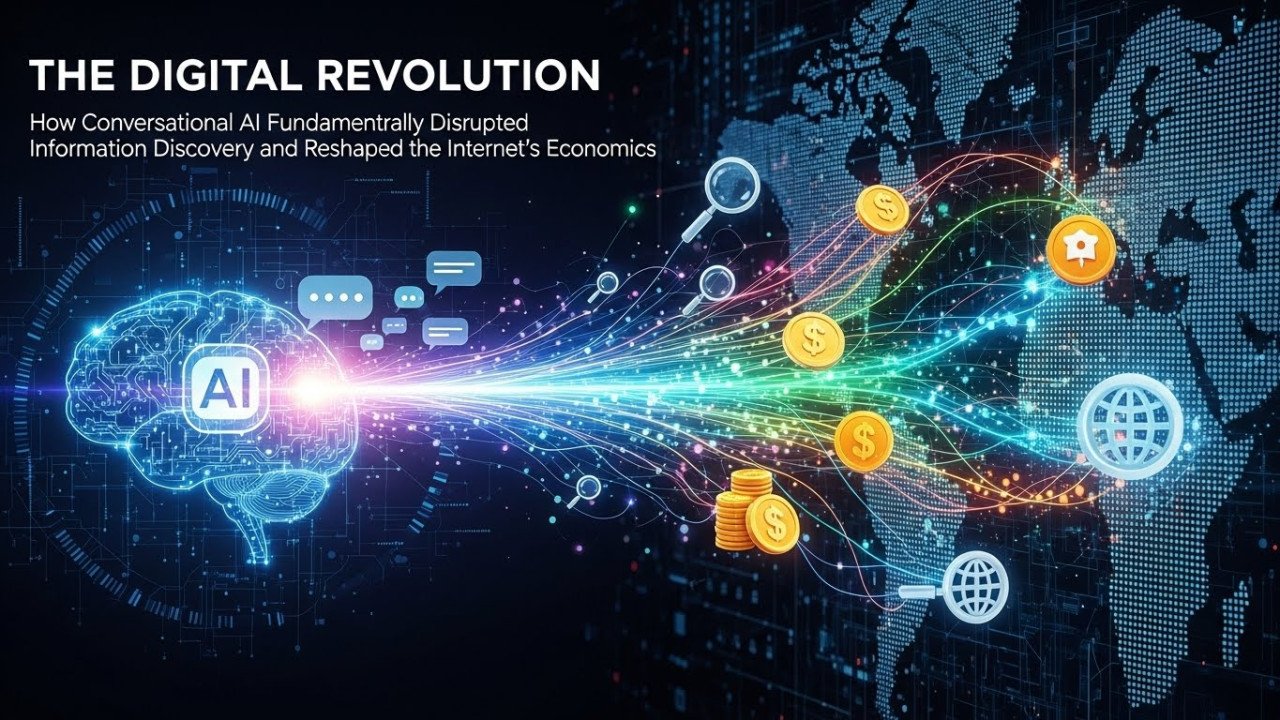
The Digital Revolution: How Conversational AI Fundamentally Disrupted Information Discovery and Reshaped the Internet's Economics
The transformation of how humanity accesses information represents one of the most significant shifts in digital history. For nearly three decades, Google's algorithm-driven search engine defined the gateway through which billions accessed information. Users typed keywords, received ranked links, clicked through to websites, and pieced together answers independently. This paradigm seemed unshakeable—reinforced by network effects, distribution advantages, and habit.
Then, in late 2022, a single application fundamentally shattered this model. ChatGPT's explosive adoption—reaching 100 million weekly users within mere months—signaled that vast populations preferred a fundamentally different information discovery mechanism. Rather than ranked links, they wanted conversational answers. Rather than clicking through multiple sources, they wanted synthesized summaries. Rather than piece-by-piece information assembly, they wanted direct guidance. This wasn't incremental preference; it was categorical preference shift, a sudden recognition that a different approach existed and that millions would abandon decades-old habits to pursue it.
This shift—from traditional search to conversational AI—represents far more than technological novelty. It catalyzed structural transformation across the entire information ecosystem, disrupting publisher economics, forcing technology giants into defensive innovation, reconstituting how professionals research, and initiating fundamental questions about how information scarcity and synthesis will be compensated in AI-native environments.
The Historical Dominance: Three Decades of Unshakeable Supremacy
Google's search dominance emerged through deliberate strategy, technological capability, and relentless execution across three decades. The company commanded approximately 90% global search market share—a concentration more typically associated with monopolistic regulation than freely chosen technology adoption.
This dominance translated into economic power of staggering proportions. Search generated approximately 60% of Alphabet's $307 billion revenue, with margins exceeding 40%. The business model was extraordinarily simple: capture intent moments when users expressed explicit information needs, match them with advertising customers willing to pay for those attention moments, and extract economics through superior targeting precision. Every human curiosity instantiation became monetizable moment.
Google maintained dominance through multiple reinforcing mechanisms. Superior search quality drove adoption. Adoption drove advertiser demand. Advertiser revenue funded relentless innovation. Competitors faced insurmountable barriers—they lacked Google's index scale, training data, computational resources, and distribution advantages.
Distribution particularly mattered. Google paid approximately $20 billion annually to maintain iPhone default status. Similar arrangements across manufacturers, browsers, and devices created contractual barriers competitors couldn't overcome through better products. Users rarely switched from defaults unless actively motivated; Google paid billions ensuring active motivation rarely emerged.
Search quality and habit created additional stickiness. Users had accumulated 20+ years of conditioning around Google interface, query patterns, and link-based interaction. The cognitive cost of switching exceeded perceived benefits for most users. This switching cost advantage proved more valuable than any technological superiority—technological gaps could close relatively quickly; switching cost gaps persisted.
The business model generated unprecedented wealth concentration. Google's dominance created an earnings stream funding extraordinary R&D investments, shareholder returns, and strategic acquisitions that fortified competitive advantages. Competitors operated in resource-constrained environments by comparison; Google operated with effectively unlimited capital.
This dominance seemed resilient to plausible competitive threats through 2022. Bing, despite Microsoft's enormous resources, never captured more than 4% market share despite being technically competitive with Google. Specialized search engines (DuckDuckGo prioritizing privacy, Reddit search surfaces community perspectives) carved niche positions but failed to meaningfully erode Google's core dominance. The consensus among sophisticated observers suggested that whatever technology emerged next, Google possessed resources and positioning to maintain relevance.
This consensus proved dramatically incorrect.
The ChatGPT Shock: When Paradigm Shift Became Undeniable
ChatGPT's launch in November 2022 shocked tech leadership with intensity few anticipated. The application wasn't technically revolutionary—similar capabilities existed in academic research and enterprise applications. What was revolutionary was the user experience. For the first time, millions interacted with AI that responded conversationally, maintained context across multi-turn exchanges, provided reasoning explanations, and felt less like querying databases and more like consulting knowledgeable humans.
Within two months, ChatGPT accumulated 100 million users—faster adoption than any consumer application in history. By December 2025, that number reached 800 million—an explosion that fundamentally changed technology industry dynamics.
What shocked Google's leadership most wasn't ChatGPT's technical capability—the company recognized it could build equivalent or superior models. What shocked them was the visceral revelation that millions of users preferred something fundamentally different from what Google provided. Users weren't demanding "Google but better." They were demanding categorical alternative: conversational guidance rather than ranked links, synthesis rather than aggregation, reasoning explanation rather than credibility signals.
This distinction mattered profoundly. Google could improve search quality indefinitely, and it would matter minimally if users had fundamentally concluded they preferred different information acquisition modality. Technological superiority within your category provides no advantage if customers prefer different categories entirely.
Inside Google, panic spread with unusual intensity. The company recognized it faced not technological lag but strategic discontinuity—it had optimized for previous paradigm and potentially risked displacement through paradigm shift. Internal communications revealed alarm among executives who had spent careers building dominance around search-engine paradigm discovering that paradigm itself faced existential threat.
Market Behavior Shifts: Measuring the Disruption
The transformation manifested measurably across multiple metrics simultaneously, validating that the shift represented genuine behavioral change rather than curiosity-driven experimentation.
Search Volume Consolidation: ChatGPT-driven traffic surged 80.9% year-over-year between April 2024 and March 2025, expanding from 30.5 billion visits to 55.2 billion visits. This explosive growth represented not marginal improvement but fundamental adoption acceleration.
Simultaneously, traditional search engine traffic remained essentially flat—declining 0.51% to 1.86 trillion visits over the same period. Google still processed 15+ billion searches daily, vastly exceeding ChatGPT's approximately 2.5 billion daily prompts. Yet the trajectory diverged sharply: traditional search stagnating while conversational AI exploded.
User Behavior Evolution: Research indicated approximately 14.3% of Google users also used ChatGPT for search-like queries by August 2025—a minority but growing cohort of switchers or dual-tool users. More significantly, among younger demographics (under 30), adoption approached 58%, signaling generational preference shift that would expand as younger demographics displaced older ones.
An AP-NORC poll revealed that approximately 60% of U.S. adults using AI did so primarily for information searches—marking it as the leading AI application, surpassing content generation, coding assistance, or creative work. Among under-30 demographics, this figure reached 74%.
First-Stop Mentality: Perhaps most disruptive: approximately 55% of respondents reported they now relied on AI chatbots for tasks they would have previously directed to Google Search. This represented not supplementary tool adoption but default tool replacement for certain user segments.
The shift concentrated particularly around informational queries—straightforward "what is," "how do I," and "explain" questions that represented enormous search volume. These queries precisely matched ChatGPT's strengths: conversational explanation, contextual clarity, iterative refinement. Users discovered ChatGPT addressed these queries more efficiently than traditional search.
Engagement Paradox: Data revealed a curious dynamic: while ChatGPT volumes grew explosively, engagement metrics diverged. ChatGPT-driven visits showed 1.73% higher engagement than organic search overall, yet ChatGPT engagement declined 11.43% year-over-year, while organic search engagement grew 4.71%. This suggested that while users increasingly chose ChatGPT, they engaged less intensively within ChatGPT conversations—a pattern suggesting more efficient information delivery requiring fewer iterative queries.
Google's Defensive Response: Innovation Under Pressure
Google's strategic response evolved across multiple dimensions, reflecting recognition that incremental product improvement wouldn't address categorical threat from competitors operating in different paradigm.
AI Overviews Rollout: The company introduced AI-generated summaries appearing atop search results, synthesizing information from multiple sources into coherent answers without requiring users to click links. This represented elegant strategic move: adopt competitive feature threatening traditional search while maintaining the platform through which it delivered the feature.
AI Overviews expanded rapidly—reaching approximately 31% of searches by late 2025, up from nearly zero in early 2024. More significantly, they expanded from informational queries into commercial searches where monetization concentrates, demonstrating AI Overviews could enhance search without destroying advertising economics.
Yet AI Overviews created immediate dilemmas. Click-through rates on organic results plummeted where AI Overviews appeared—declining from approximately 15% to 8% in comparative studies. Research from Ahrefs in April 2025 showed 34.5% CTR reduction for Position 1 when AI summaries appeared. Some publishers reported 89% click-through rate declines (DMG Media, September 2025).
This asymmetry created philosophical crisis. If AI synthesized content without sending traffic to publishers, the content ecosystem collapsed. Publishers couldn't monetize traffic they didn't receive. Google would run out of quality information to synthesize. Yet users clearly preferred synthesized answers over link lists. Google faced Sophie's choice between user satisfaction and ecosystem health.
Gemini Integration: Google launched successive Gemini iterations (culminating in Gemini 3 Pro, November 2025) representing the company's conversational AI answer to ChatGPT. Rather than separate product, Gemini integrated directly into Google Search, recognizing that distribution would prove decisive competitive advantage.
LMArena benchmarking ranked Gemini 3 Pro among globally top-performing models, competing effectively against OpenAI's offerings. More significantly, Gemini 3 launched directly integrated into Google Search—Google wasn't hedging bets on separate application but betting everything on infusing core product with generative AI.
This integration strategy preserved distribution advantages while attempting to neutralize competitive threat posed by standalone AI applications. Users wanting conversational search could access equivalent or superior capabilities without abandoning Google ecosystem.
AI Mode Launch: Google's most ambitious response emerged with AI Mode (May 2025)—CEO Sundar Pichai called it "total reimagining of Search." The feature represented conversational search experience within Google's interface, directly addressing ChatGPT competition through native offering.
AI Mode broke complex questions into multiple research streams, synthesized findings from dozens of sources, and provided follow-up questions for deeper exploration. Early data showed AI Mode users asked longer, more nuanced questions and expected comprehensive answers spanning multiple perspectives—users treating it as research assistant rather than quick lookup tool.
Disruption of Publisher Economics: The Structural Crisis
The transformation created genuine existential crisis for publishers and content creators who built business models entirely around search referral traffic.
Traffic Collapse: Publishers globally reported dramatic traffic declines directly attributable to AI Overviews and conversational search displacement. The Guardian noted sites previously ranked first could lose up to 79% of traffic when pushed below AI Overview. Smaller publishers relying entirely on organic search faced "traffic apocalypse" scenarios where their economic model collapsed overnight.
DMG Media reported 89% click-through rate decline. Digital publishers across sectors—from travel to health to finance—reported 40-60% traffic declines. These weren't competitive losses where better competitors displaced them; they were paradigm losses where the information discovery mechanism itself shifted.
Zero-Click Phenomenon: Zero-click searches—where users received sufficient information from search results without clicking to any website—expanded from approximately 15% of queries to 69% across all queries by 2025. This represented not marginal trend but overwhelming majority pattern: users got what they needed without visiting publisher sites.
Monetization Pressure: Without traffic, publishers couldn't monetize advertising, sponsorships, or affiliate relationships. Display advertising networks suffered severe revenue declines as campaigns against AI-summarized content proved less effective. Affiliate revenue evaporated where users received direct answers about products without visiting retailer sites.
Subscription models simultaneously weakened. Users never reached paywalls if they received sufficient information from AI-synthesized answers. Newsletters gained importance as publishers shifted toward direct audience relationships, recognizing borrowed traffic through search would no longer sustain businesses.
Content Investment Sustainability Questions: Publishers increasingly questioned whether investing in original content creation remained economically viable if content would be synthesized into AI answers without driving traffic or revenue. If Google's AI Overviews extracted content value while sending no compensation to creators, why should publishers continue investing in content creation rather than investing those resources in owned audiences or subscription development?
Strategic Implications: Ecosystem Resilience and Future Economics
The disruption raised fundamental questions about internet ecosystem sustainability. The traditional model depended on content creator investment funded through search referral traffic monetization. If search fundamentally shifted from link-referral to AI-synthesis without equivalent traffic or direct compensation, would creators continue investing in original research, journalism, and content?
Content Ecosystem at Risk: Gartner predicted web searches would decrease approximately 25% by 2026 due to AI chatbot availability. If this projection materialized, publishers dependent on search would face structural revenue declines forcing business model transformation or exit.
Publishers theorized scenarios about AI adoption expansion:
30% AI query adoption (current): AI generates snippets for nearly one-third of queries. Publisher impact moderate—display ad revenue drops, informational publishers heavily affected, but differentiated publishers with unique analysis retain relative strength.
55% AI query adoption (medium term): Fewer than half of searches generate clicks to websites. Traditional search becomes secondary. Ad-dependent publishers lose 40-60% of search traffic. Subscription models falter. Small and mid-sized publishers begin consolidating or closing.
75% AI query adoption (long-term): Traditional publishing business models largely collapse. Only premium subscription publishers with deeply loyal audiences survive in familiar form. Content creation shifts toward licensing deals as publishers become data suppliers rather than consumer-facing brands.
Publishers contemplating long-term strategy increasingly recognized that adaptation required moving away from borrowed search traffic and toward owned channels—newsletters, apps, direct relationships, premium subscription. Publishers succeeding in emerging environment were those who recognized they needed to compete for attention directly rather than relying on search as traffic source.
Licensing and Compensation Models: Google and competing platforms began exploring whether direct publisher compensation—through licensing deals, revenue sharing, or other mechanisms—could incentivize content creation despite reduced search traffic benefits.
However, the economics proved challenging. If AI systems reduced click-through rates while maintaining content value, how would compensation be structured? Volume-based payments? Revenue sharing? Attribution-based compensation? No clear economically workable model emerged, leaving publishers and search engines in uncomfortable standoff.
Competitive Dynamics: Emerging Alternatives and Market Fragmentation
The disruption created competitive opportunities for platforms positioning themselves differently than Google.
Perplexity AI captured meaningful adoption by emphasizing transparency—explicitly citing sources informing responses, enabling users to verify independently. For researchers, journalists, and professionals prioritizing source verification, Perplexity's positioning proved attractive.
OpenAI's Expanded Offerings through ChatGPT integration with web search and custom applications created alternatives to Google for users seeking conversational research experiences.
Microsoft's Copilot leveraged enterprise relationships and Office integration to position AI assistance throughout workplace productivity applications.
Emerging Platforms like Anthropic's Claude captured users prioritizing reasoning capability and safety-focused design over universal feature breadth.
Rather than winner-take-all outcome, the market fragmented into plurality where different competitors won with different segments:
ChatGPT dominated for creative work and general conversation
Perplexity led for research requiring source verification
Copilot succeeded for Microsoft ecosystem productivity
Claude attracted reasoning-focused professionals
Google maintained dominance for local search, shopping, and news
This fragmentation represented historic shift from decades-long Google monopoly toward competitive market with multiple capable platforms.
SEO and Content Strategy Transformation: Adapt or Become Irrelevant
The disruption forced fundamental reconceptualization of how businesses should approach online visibility.
Traditional SEO Obsolescence: Traditional SEO focused on keyword ranking, link building, and SERP positioning. Yet if 69% of searches contained zero clicks, ranking position became substantially less valuable. A first-position ranking driving clicks meant nothing if AI Overviews appeared above the ranking, reducing clicks 34-79%.
Answer Engine Optimization Emergence: Businesses increasingly recognized need for "Answer Engine Optimization"—optimization for AI systems rather than traditional search rankings. This involved:
Structured data implementation enabling AI systems to parse content
Clear authority signals establishing expertise AI systems recognized
Format optimization for content AI systems could synthesize
Citation readiness making content attractive source for AI references
Content Strategy Pivot: Rather than aggregating information for search traffic, successful publishers increasingly invested in original research, exclusive analysis, and differentiated perspectives that AI systems couldn't synthesize from existing sources.
Publishers with unique datasets, proprietary research, and exclusive perspectives retained traffic and value even amid AI disruption. Publishers recycling syndicated information faced collapse as their value proposition—easy aggregation—became obsolete.
The Broader Implications: Information Discovery Transformation
The shift from search to conversational AI represented fundamental change in how humans would interact with information infrastructure.
Behavioral Shift from Clicking to Conversing: Users increasingly recognized they preferred natural language dialogue about complex topics rather than evaluating ranked lists. This shift extended beyond information retrieval into research methodology—users conducting sophisticated analysis discovered conversational interaction with AI enabled iterative refinement impossible through traditional search.
Personalization and Context: Conversational AI systems maintained conversation memory, understanding that follow-up questions related to previous context. This enabled personalized research adapting to individual needs in ways traditional search couldn't replicate.
Reasoning Transparency: Conversational AI systems could explain reasoning, provide citations, acknowledge uncertainty, and engage in Socratic dialogue—research methodologies more sophisticated than traditional search's "here are ranked links" interface.
Multimodal Integration: Emerging AI systems processed text, images, video, and audio—enabling more comprehensive information discovery than text-only search.
Frequently Asked Questions: Understanding the Transformation
Will traditional search completely disappear?
No. Traditional search remains valuable for specific use cases (shopping, local searches, finding specific websites) where ranked links provide direct utility. However, traditional search's dominance for informational and research queries will continue eroding as conversational alternatives mature.
Are publishers really facing existential threat?
Yes, legitimately. Publishers entirely dependent on search referral traffic are facing structural revenue decline that will force business model transformation. Publishers will survive through differentiation (exclusive content), owned audiences, premium subscriptions, or licensing arrangements—not through search traffic alone.
Is this shift permanent or temporary?
Permanent. The underlying technology continues advancing. User adoption accelerates rather than plateaus. Competition will intensify rather than consolidate. Search-to-conversational transition will continue deepening.
How should businesses adapt?
Immediately pivot away from search traffic dependency. Invest in owned audience development, direct relationships, unique content, and authority positioning. Optimize for both traditional search (maintaining existing traffic) and answer engines (positioning for future). Build direct customer relationships rather than relying on borrowed search traffic.
Will Google maintain dominance?
Likely, but reduced. Google's integration of AI into search, distribution advantages, and ecosystem lock-in provide resilience. However, competitors capturing specific segments and reduced overall search dominance represent genuine competitive threat compared to historical monopoly.
What happens to advertising models?
Fundamental transformation. Display advertising's effectiveness against AI-summarized content remains unproven. Conversational AI advertising remains nascent and generally rejected by users. Search advertising faces pressure as click-through rates decline. New monetization models (subscriptions, licensing, sponsored responses) will likely emerge, but advertising's dominance will diminish.
How long until conversational AI dominates?
Current trajectory suggests 30-40% of informational queries by 2027, accelerating thereafter. Full adoption of conversational paradigm for most query types likely reaches 70%+ within 10 years. However, traditional search will remain valuable for certain query types indefinitely.
What should publishers do right now?
Immediate actions: develop owned audience channels, build email lists, create subscription offerings, invest in exclusive/unique content, establish direct customer relationships. Medium-term: explore licensing with AI platforms, optimize for answer engines, develop brand loyalty reducing search dependency. Long-term: transition business model from search-traffic-dependent to subscription/direct-relationship-dependent.




Comments (0)
No comments found