


Ethical AI Content Creation 2025: Building Trust with Human-Centric Responsibility
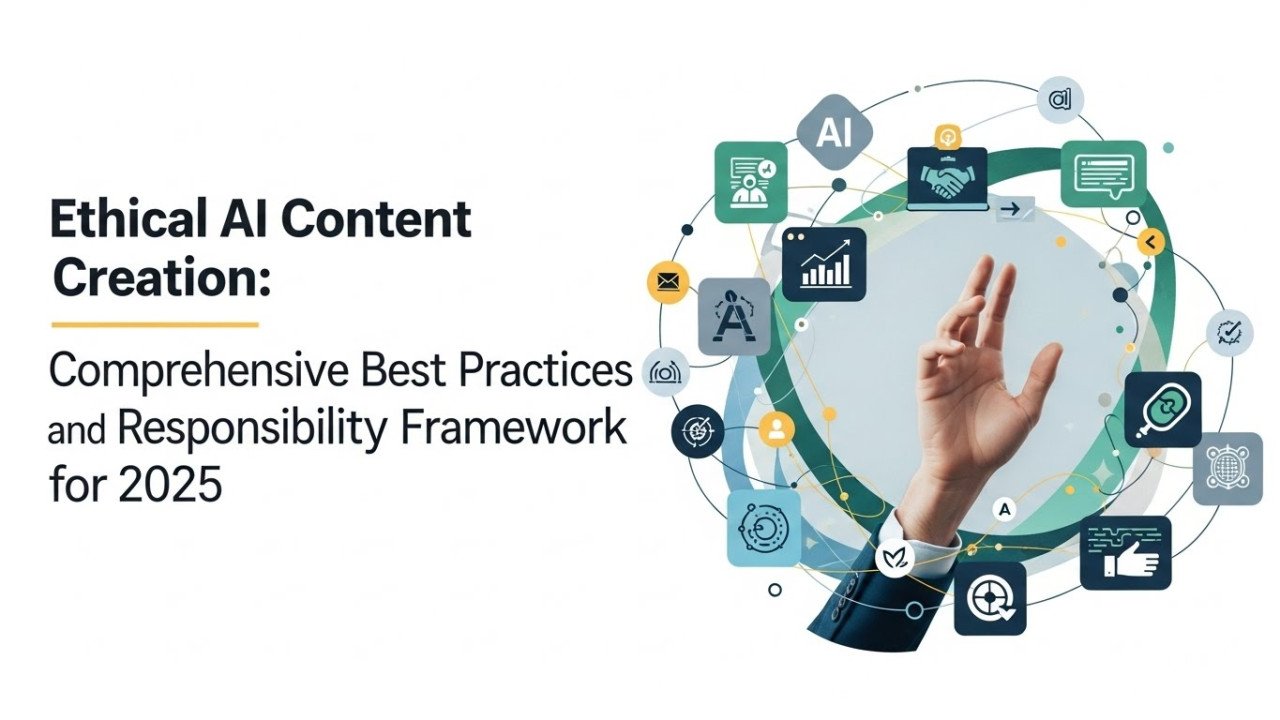
Ethical AI Content Creation: Comprehensive Best Practices and Responsibility Framework for 2025
The rapid democratization of generative AI has placed powerful content creation tools in the hands of millions of creators, entrepreneurs, marketers, and organizations—fundamentally transforming creative industries while simultaneously introducing urgent ethical challenges around transparency, accuracy, bias, copyright protection, and societal impact. As AI-generated and AI-assisted content proliferates across digital platforms, addressing these ethical dimensions has transitioned from optional best practice to essential requirement for maintaining audience trust, regulatory compliance, and genuine professional responsibility. The 2025 landscape reflects a critical inflection point: organizations and individuals implementing robust ethical frameworks gain competitive advantages through enhanced audience trust and regulatory resilience, while those cutting corners risk reputational damage, legal jeopardy, and erosion of the credibility essential for sustainable long-term success.
The ethical imperative extends beyond corporate responsibility or legal compliance—it reflects a fundamental recognition that AI systems, for all their capabilities, remain tools lacking the contextual understanding, human values, and accountability that should anchor content creation. A now-infamous example illustrates this vividly: Microsoft's AI-generated Ottawa travel guide recommended a food bank as a vacation destination, demonstrating how AI can generate technically coherent but contextually absurd and potentially harmful content without human oversight. This incident crystallized a crucial insight: vetting AI outputs requires profound human judgment that transcends simple reviewing—meaning evaluating content not just for grammar and coherence but for accuracy, appropriateness, bias, harmful stereotyping, and alignment with audience values. Building ethical AI practices means establishing deliberate, human-centered frameworks that leverage AI's efficiency while preserving human values, accountability, and contextual wisdom.
Transparency and Disclosure: The Foundation of Ethical Practice
Mandatory Disclosure of AI Involvement
Transparency about AI involvement in content creation has transitioned from best practice to legal requirement across major regulatory jurisdictions. The EU AI Act (effective March 2025) mandates that AI-generated or manipulated content be disclosed in both human-readable and machine-readable formats, with specific requirements for deepfakes, audio, video, and text content that could deceive audiences. India's proposed regulations require that visual media include visible markers covering at least 10 percent of the display area, while audio clips must disclose AI generation during the first 10 percent of playback. These mandates reflect a regulatory consensus that audiences have fundamental rights to know when they are encountering AI-generated content.
The practical application involves careful assessment of when disclosure is essential versus when it represents over-communication. Disclosure becomes critical when AI use could affect audience trust, transparency about authorship, or understanding of content creation. A press release including AI-generated quotes or messaging warrants explicit transparency because audiences and journalists reasonably expect fully human authorship in editorial contexts. Marketing copy using AI drafting as an initial stage before substantial human refinement exists on a disclosure continuum: simple notification that "this company uses AI in its creative" generally fails to provide sufficient transparency, while specific disclosure indicating which content elements involved AI assists audiences in evaluating credibility.
Research from the Public Relations Society of America emphasizes that disclosure decisions require contextual judgment rather than blanket policies. The core principle involves asking: "Would audiences care about AI involvement in their assessment of this content's value, credibility, or appropriateness?". If the answer is yes, transparency is ethically mandatory; if no, disclosure still strengthens trust through demonstrated honesty but may not be essential.
The mechanisms for disclosure should be specific rather than generic. Instead of burying disclaimer language in website footers, effective disclosure specifies exactly which content elements involved AI—such as "headline generated using AI, subsequently edited for accuracy and brand voice" or "initial draft synthesized from multiple sources via AI, substantially rewritten with editorial judgment and original analysis". Machine-readable metadata embedding this information into file structures enables automated systems to detect and verify AI involvement while supporting human review.
Explainability and Decision Documentation
Beyond simple disclosure that AI was involved, ethical practice demands that organizations can explain how AI systems reached specific conclusions and what influenced their outputs—a requirement particularly acute for high-stakes applications where AI recommendations guide consequential decisions. This explainability requirement serves multiple purposes: it enables users to understand AI logic sufficiently to question recommendations critically; it supports regulatory compliance and audit trails; and it identifies potential bias or errors requiring correction.
Techniques for enhancing explainability include:
Model cards: Technical documentation for individual AI models specifying training data, performance metrics across demographic groups, known limitations, and recommended use cases. This transparency enables users to understand when models are likely to perform well versus when caution is warranted.
Explainable AI (XAI) methods including SHAP (Shapley Additive Explanations) and LIME (Local Interpretable Model-agnostic Explanations) generate human-interpretable explanations of how specific AI decisions were reached. Rather than accepting opaque outputs, these techniques surface which input factors most influenced outputs, enabling human reviewers to assess whether those factors represent legitimate criteria or biased proxies.
Natural language explanations: AI systems generating accompanying text explanations of their outputs in plain language support non-technical stakeholders in understanding recommendations. A hiring AI, for instance, might explain that it recommended candidate A because their skill profile matched historical high performers in the role—an explanation enabling human judgment about whether this criterion appropriately reflects job requirements versus represents historical bias.
Documentation of AI involvement in content creation processes serves accountability purposes: researchers should document which AI tools were used, their versions, specific prompts or parameters, and how outputs were modified post-generation. This creates audit trails enabling verification of claims, investigation of errors or bias, and compliance with regulatory expectations.
Accuracy, Fact-Checking, and Misinformation Prevention
Verification Protocols and Human Oversight
Generative AI systems, for all their sophistication, generate factually inaccurate content with concerning frequency—a phenomenon termed "hallucination"—where the system confidently produces false information, fabricated citations, or contextually inappropriate recommendations. An AI might cite nonexistent academic papers, invent statistics supporting its narrative, or confidently state falsehoods in authoritative tone. These failures are not occasional glitches but systematic vulnerabilities of neural network architecture, meaning AI outputs should never be trusted without independent verification.
Ethical content creation mandates rigorous verification protocols treating AI outputs as unvetted drafts requiring thorough fact-checking before publication. This involves:
Source verification: Checking all citations, statistics, and factual claims in AI-generated content against original sources. If AI cites academic papers, the cited papers must actually exist, contain the quoted text, and support the interpretation AI assigned. If AI generates statistics, independent verification against reliable data sources is essential.
Multi-stage review processes: Implementing review by subject matter experts, editors, and fact-checkers rather than relying on single-stage approval. Different reviewers catch different errors: subject matter experts identify domain-specific inaccuracies, editors assess clarity and tone, fact-checkers verify factual claims. The Content Marketing Institute case study emphasizes this through their "vetting" philosophy: rather than a quick "review" suggesting light scrutiny, vetting implies substantial checking for accuracy, context, appropriateness, tone, and brand alignment.
Contextual assessment: Evaluating whether AI outputs make contextual sense even if individually accurate. A travel guide AI recommending a food bank as a tourist destination represents the kind of contextual failure that survives simple fact-checking but requires human judgment to catch. Asking "Does this recommendation make sense in context? Would a typical reader react with this intended response?" catches such errors.
Bias and stereotyping detection: Reviewing AI outputs for biased language, stereotyping, exclusionary framing, or other content that technically may not be "false" but is harmful, discriminatory, or inappropriate. This requires sensitivity and diversity in review teams, as different reviewers recognize different categories of bias.
Organizations publishing substantial content should establish clear verification standards as organizational policy rather than leaving verification to individual writer discretion. This standardization improves consistency while reducing the burden on individual contributors.
Handling Uncertainty and Ambiguity
Ethical AI practice requires transparent acknowledgment when AI systems encounter ambiguous situations where multiple interpretations are defensible rather than presenting uncertain conclusions with false confidence. If AI generates multiple possible conclusions from available evidence, responsible practice involves presenting these alternatives with associated confidence levels rather than arbitrarily selecting one.
When publishing AI-assisted content addressing matters where reasonable people disagree or where evidence is incomplete, ethical presentation involves:
Clearly stating what is known with high confidence versus what represents interpretation or judgment
Presenting alternative perspectives when multiple defensible viewpoints exist
Acknowledging limitations in available evidence or analysis
Inviting audience critique and feedback through comment sections, email addresses, or feedback forms
This transparent acknowledgment of uncertainty paradoxically builds greater trust than false certainty, as audiences recognize intellectual honesty.
Bias Mitigation and Fairness in AI-Generated Content
Understanding Bias Sources and Manifestations
AI systems inherit and amplify biases present in their training data and the datasets used to evaluate them—a phenomenon referred to as implicit bias distinct from explicit programming of discriminatory rules. If an AI image generator trained on photographs where historically underrepresented groups appear less frequently generates images that underrepresent those groups, that represents implicit bias where no human explicitly coded discrimination. Similarly, language models trained on internet text absorb societal biases encoded in language: if certain demographics are underrepresented in training data or portrayed stereotypically, the AI reproduces these patterns.
The consequences are material. AI-generated job descriptions may incorporate gendered language inadvertently excluding certain demographics. AI hiring systems may score candidates differently based on protected characteristics through proxy discrimination—techniques that correlation with protected characteristics even if not explicitly used. AI-generated illustrations may perpetuate stereotypes or exclude representation of marginalized groups. These biased outputs cause harm by perpetuating discrimination, limiting opportunities, and reinforcing stereotypes.
Identifying bias requires specific mechanisms rather than assuming it away:
Fairness audits: Systematic evaluation of AI outputs across demographic groups to identify disparate impact—differences in outcomes between groups that might indicate bias. This involves running identical or equivalent inputs through AI systems and comparing outputs across demographic groups: Do image generators create equivalent diversity of body types, racial presentations, gender expressions when equivalent prompts are used? Do language models generate content with equivalent sentiment toward different demographic groups?.
Adversarial testing: Intentionally trying to make AI systems generate biased output to identify vulnerability areas requiring mitigation. If you prompt a system with identical scenarios except demographic characteristics, do outputs differ in ways suggesting bias?.
Stakeholder feedback: Engaging with communities potentially affected by AI outputs to surface biases that may not be apparent to system developers or evaluators. What seems innocuous to engineers may be offensive or exclusionary to affected communities.
Mitigation Strategies and Inclusive Design
Addressing AI bias requires interventions across the full system lifecycle—from data collection through deployment and monitoring:
Balanced training data: Ensuring AI systems are trained on datasets representing diverse demographic groups, perspectives, and contexts. If training data overrepresents certain groups, AI systems will develop biased patterns reflecting that imbalance. Data augmentation and reweighting techniques can address representation imbalances, ensuring models learn from balanced datasets.
Fairness-aware algorithms: Implementing algorithms that explicitly optimize for fairness constraints during training, preventing models from developing discriminatory patterns. Adversarial debiasing involves training competing neural networks—one generating model outputs and another specifically trying to identify and penalize bias—forcing the primary model to generate fairer outputs.
Diverse development teams: Including perspectives from individuals with different racial, gender, socioeconomic, ability, and demographic backgrounds on AI development teams, as diverse teams catch biases that homogeneous teams miss. This diversity must extend beyond tokenism to meaningful representation in decision-making roles.
Regular monitoring: Continuously auditing AI systems after deployment to identify emerging biases. Bias can emerge when models encounter new contexts, user populations, or data distributions not represented in training.
Human-in-the-loop processes: Keeping humans centrally involved in reviewing AI recommendations, particularly for high-stakes decisions affecting individuals' opportunities or rights. Human reviewers can catch biased outputs and override AI recommendations when bias is detected.
Transparency about limitations: Clearly communicating known biases or limitations of AI systems to users, enabling them to apply appropriate skepticism. Rather than obscuring limitations, responsible AI deployment surfaces them.
For content creators specifically, this translates to:
Checking AI-generated content for stereotyping, underrepresentation, or exclusionary framing before publication
Testing whether AI systems would generate equivalent content if demographic characteristics in prompts were changed
Seeking feedback from diverse reviewers on whether content perpetuates harmful biases
Refusing to publish content that stereotypes or excludes groups, even if technically "accurate"
Copyright, Attribution, and Intellectual Property Ethics
Attribution and Source Transparency
Ethical AI content creation requires clear attribution of sources underlying AI outputs and transparent acknowledgment of any copyrighted material that influenced generation. While copyright law remains unsettled regarding whether training AI models on copyrighted works constitutes infringement, ethical practice doesn't wait for courts to clarify—it assumes responsibility for honest source attribution.
When AI generates content synthesizing information from multiple sources, ethical practice involves:
Identifying and citing key sources informing the synthesis
Distinguishing between direct quotations (requiring explicit citation), close paraphrasing (requiring attribution), and original analysis
Disclosing when AI training included specific published works relevant to the content
When reasonable, linking to source material enabling readers to verify and explore original research
For visual content, this becomes particularly important given image generators trained on billions of copyrighted photographs and artwork. While the generated image is technically new (not a direct copy), it reflects training on copyrighted originals. Acknowledging this source relationship maintains intellectual honesty and respects the creative labor underlying training data.
Ownership and Rights Management
Organizations using AI to generate content for commercial purposes should establish clear internal ownership policies specifying who owns AI-generated content and defining usage rights. The Copyright Office makes clear that works created entirely by AI cannot be copyrighted; however, hybrid human-AI works can receive copyright protection for human contributions if the human's role was substantial and creatively distinct from AI generation.
Responsible practice involves:
Documenting human creative contributions to AI-assisted works sufficiently that copyright protection claims are defensible
Clearly specifying in contracts and policies whether employees, contractors, or organizations own AI-generated outputs
Obtaining licenses for AI platforms used in content generation ensuring the organization retains rights to use outputs
Reviewing platform terms of service ensuring they don't claim ownership or training rights over generated content
For creators selling AI-assisted content (stock photos, templates, designs), explicit disclosure that content involves AI generation enables buyers to make informed purchasing decisions and protects against later disputes.
Deepfakes, Synthetic Media, and Right of Publicity
Preventing Unauthorized Use of Identity and Likeness
Deepfakes—hyper-realistic AI-generated or manipulated audio, video, or images depicting people saying or doing things they never actually said or did—represent one of the most concerning applications of generative AI from ethical and legal standpoints. Creating realistic deepfakes of identifiable people without consent, particularly for commercial exploitation or defamatory purposes, violates right of publicity laws, can constitute defamation, and in some jurisdictions may violate specific anti-deepfake legislation.
Ethical guidelines for synthetic media should prohibit:
Commercial identity exploitation: Creating deepfakes that appear to show celebrities endorsing products, expressing political views, or engaging in activities they never actually endorsed without explicit consent. Such uses violate publicity rights and may constitute fraud against consumers relying on false endorsements.
Intimate imagery without consent: Generating fake nude images, intimate scenarios, or sexually explicit content depicting real people, which causes substantial harm, violates privacy, may constitute sexual harassment, and in many jurisdictions is now specifically criminalized.
Defamatory deepfakes: Creating false evidence of someone committing crimes, expressing racist or sexist views, or engaging in unethical behavior, even if for humorous purposes, causes harm and may generate defamation liability.
Political manipulation: Using deepfakes to misrepresent statements by political figures, manipulate voters, or interfere with elections represents a grave threat to democratic integrity.
Detection and Disclosure Standards
When synthetic media is created for legitimate purposes—artistic expression, satire, entertainment, educational illustration—ethical practice requires clear disclosure enabling audiences to understand what they're viewing represents synthetic media rather than authentic evidence. Without disclosure, audiences may believe deepfakes are genuine, leading to reputational damage, emotional harm, or misinformation spread.
Disclosure standards should specify:
Whether audio, video, or images involve AI generation or manipulation
When generative AI creates entirely fictional content versus modifies authentic footage
Where context matters, what authentic underlying material existed and how AI transformed it
The EU AI Act includes exceptions for artistic, educational, and satirical contexts where disclosing that media is synthetic might compromise creative intent, but these exceptions apply only when such use is clearly distinguishable by context and carries editorial responsibility. A clearly labeled satirical video doesn't require technical watermarking; documentary with deepfakes of historical figures does require disclosure to support viewer understanding.
Detection infrastructure is rapidly developing: AI Copilot PCs are expected to ship with integrated deepfake detection capabilities, watermarking systems embed imperceptible markers enabling verification, and blockchain-based verification systems create immutable records of authentic media. Organizations working with synthetic media should implement these detection capabilities to verify authenticity of materials and support audience confidence.
Content Moderation and Harm Prevention
Establishing Clear Guidelines and Proactive Systems
Responsible AI content creation involves preventing harmful content generation—hate speech, harassment, violence promotion, graphic sexual content, child safety violations—through clear guidelines and proactive moderation systems. While AI tools like ChatGPT include built-in safety filters, responsible deployers should implement additional safeguards matching their specific contexts and values.
This involves:
Clear content policies: Explicitly defining what content is not permitted on platforms or systems—hate speech, harassment, violence, explicit sexual content, misinformation, etc.—with specific examples clarifying ambiguous concepts. A dating platform's prohibition of explicit content differs from a medical education platform's standards.
Proactive screening: Rather than waiting for users to report problematic content, implement real-time content moderation using APIs, custom classifiers, and AI systems that flag potentially violative content before it reaches audiences. This prevents harm before it escalates.
AI-powered detection at scale: Leverage AI for identifying patterns of abuse (repeated hate speech, coordinated harassment campaigns, anomalous behavior) that would overwhelm human moderators handling volume. AI excels at pattern detection and can identify emerging threats requiring human investigation.
Human-in-the-loop oversight: Combine automated detection with human moderators for context-dependent decisions where nuance matters. Is a statement satire or serious threat? Education or harmful misinformation? AI struggles with context; humans excel at it.
Transparent appeals processes: When content is removed or accounts suspended, provide transparent explanation and meaningful opportunity to appeal, reducing false positives where legitimate content is wrongly removed.
Balancing Safety and Expression
Content moderation necessarily navigates tensions between preventing harm and preserving freedom of expression—a tension requiring deliberate frameworks rather than assuming one value always dominates. Sweeping content removal protecting all users from offense suppresses legitimate speech; conversely, unlimited expression permits harassment and abuse.
Ethical moderation frameworks typically distinguish between:
Clear policy violations: Content explicitly violating established rules (hate speech, child safety violations, explicit violence) warrants prompt removal with minimal ambiguity.
Context-dependent content: Material that might be problematic in some contexts but appropriate in others (nudity in artistic versus pornographic contexts, historical slurs in educational versus offensive contexts) requires human judgment applying community standards.
Borderline cases: Content that reasonable people could disagree about—controversial political speech, insulting but not harassing language, unverified but not proven false claims—benefit from transparency about removal decisions rather than automatic deletion.
Successful moderation systems typically remove content that clearly violates policies, flag borderline content for human review applying contextual judgment, and generally permit controversial speech that doesn't clearly harm while providing audiences with tools to avoid content they find objectionable.
Education and Organizational Implementation
Building Ethical AI Literacy Across Organizations
Creating ethical AI practices requires moving beyond individual responsibility to organizational systems ensuring consistent ethical approaches. This involves:
Training and education: Ensuring all employees involved in AI use understand ethical principles, organizational policies, regulatory requirements, and practical techniques for identifying and addressing ethical issues. This training should be ongoing rather than one-time, as technologies and standards evolve rapidly.
Clear organizational policies: Establishing documented guidelines for AI use across content creation, decision-making, customer interaction, and other applications. Clear policies eliminate ambiguity about what constitutes ethical use and reduce individual decision-making burden.
Governance structures: Establishing ethics committees, audit processes, and oversight mechanisms ensuring compliance with ethical principles. Regular audits of AI systems identify emerging ethical issues requiring attention.
Reporting and feedback mechanisms: Creating channels for employees, users, and stakeholders to raise ethical concerns about AI systems without fear of retaliation. Many organizations have discovered AI ethical issues through user complaints or employee whistleblowers; formalizing reporting improves issue detection.
Diversity in AI teams: Actively recruiting and retaining diverse perspectives in AI development, data science, and content creation teams, as diverse teams identify ethical issues homogeneous teams miss. This diversity must extend to decision-making roles, not just representation.
External Stakeholder Engagement
Ethical AI implementation benefits from engagement with external stakeholders—customers, communities affected by AI systems, regulators, and civil society organizations—rather than assuming internal perspectives sufficiently understand impacts. Community engagement, particularly with groups historically excluded from technology development, surfaces ethical considerations that internal teams overlook.
This involvement might include:
User research with diverse populations testing whether AI systems function equitably across demographic groups
Advisory boards including external experts providing independent ethical oversight
Transparent communication about AI systems' capabilities, limitations, and ethical considerations
Responsiveness to feedback and willingness to modify practices based on stakeholder input
Regulatory Landscape and Compliance Integration
Meeting Evolving Mandatory Requirements
Regulatory requirements for AI transparency, bias prevention, content disclosure, and deepfake labeling are rapidly expanding globally. Organizations should view regulatory compliance not as burdensome obligation but as framework articulating ethical principles worth following independently. Key developing standards include:
EU AI Act transparency requirements (effective March 2025): Mandate disclosure of AI-generated or manipulated content in human-readable and machine-readable formats.
India's proposed deepfake regulations: Requiring visible markers on synthetic visual media and AI disclosure in audio content.
Various state-level U.S. regulations: Addressing deepfakes, AI hiring decisions, and content labeling with divergent standards across jurisdictions.
Chinese regulations: Requiring platform-enforced watermarking and content disclosure for AI-generated content.
Organizations should monitor regulatory developments in key markets and implement practices exceeding minimum requirements, understanding that standards will likely tighten over time.
Conclusion: Ethical Practice as Competitive Advantage
The ethical frameworks and best practices outlined above require effort—additional review processes, disclosure systems, bias audits, governance infrastructure—creating costs and complexity beyond using AI without ethical guardrails. However, organizations implementing robust ethical practices gain substantial competitive advantages: audiences trust ethically transparent organizations more than competitors cutting corners; regulatory compliance positions organizations advantageously as standards tighten; employee satisfaction improves in organizations operating transparently; and ethical practices reduce legal and reputational risks from ethical violations discovered post-publication.
Conversely, shortcuts generate compounding risks. Content discovered to be deceptively undisclosed AI-generated content damages trust permanently; biased content generating public backlash creates lasting reputational harm; deepfakes of identifiable people trigger legal consequences and regulatory scrutiny; misinformation spreads with consequences difficult to contain. The organizations thriving in the AI era are those recognizing that AI is a tool amplifying human values—and ethical practice means ensuring those values emphasize honesty, respect, accuracy, and accountability rather than exploiting AI's capabilities to cut corners.
Building these practices requires treating ethical AI not as compliance checkbox but as operational integration—something baked into workflows, decision-making processes, and organizational culture rather than added afterward. The most successful organizations view ethics not as obstacle to AI deployment but as enabler of trustworthy, sustainable, value-creating implementations that audiences, regulators, and employees support.




Comments (0)
No comments found