


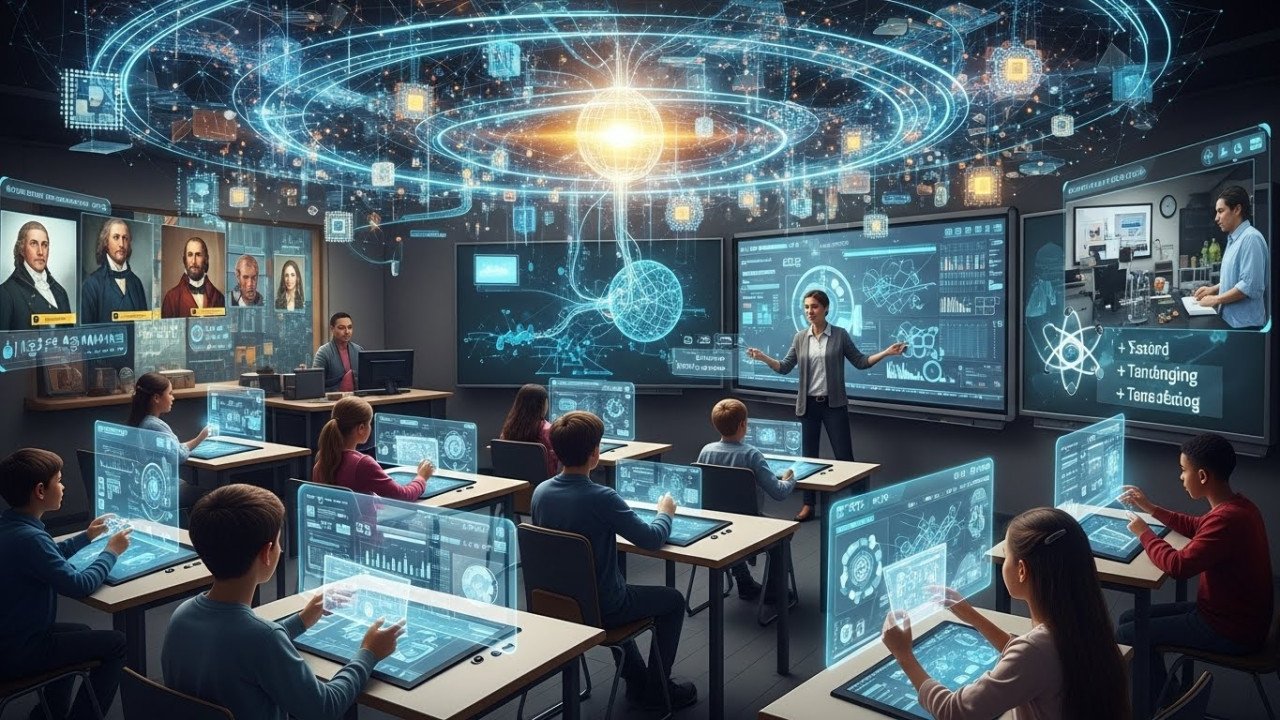
Transforming Education with AI 2026: The Future of Intelligent Learning Technology
Transforming Education Through Intelligent Technology: The Complete Guide to AI-Powered Learning Platforms and Smart Education Tools in 2025
Artificial intelligence is fundamentally reshaping educational delivery, creating a paradigm shift from one-size-fits-all instruction toward truly personalized, adaptive learning experiences tailored to individual student needs, learning styles, and pace of progress. The transformation extends far beyond simple content delivery—AI-powered platforms now encompass intelligent tutoring systems providing 24/7 personalized instruction, adaptive learning algorithms adjusting difficulty dynamically based on performance, teachers' assistants automating administrative tasks, and content creation tools generating high-quality educational materials at unprecedented speed and scale. The statistics reflect this transformation's magnitude: AI-driven personalization increases student engagement by up to 60 percent, AI-powered analytics improve course completion rates by 25-40 percent, and over 80 percent of enterprises now employ AI-enabled eLearning platforms—demonstrating that intelligent educational technology has transitioned from innovative experiment to mainstream expectation.
The educational landscape in 2025 stands at an inflection point where access to high-quality, personalized instruction is becoming democratized through AI technology. Students in under-resourced schools can access world-class tutoring through intelligent platforms, working professionals can receive customized upskilling addressing their specific competency gaps, and educators can delegate time-consuming administrative work to systems that learn and improve continuously. However, realizing this potential requires understanding both the profound capabilities of contemporary AI education tools and the important considerations around implementation, effectiveness, equity, and the irreducible role of human educators in shaping development beyond pure academic achievement.
Intelligent Tutoring Systems: The Evolution Toward Personalized Instruction
Foundational Architectures and Pedagogical Frameworks
Intelligent Tutoring Systems (ITS) represent the most sophisticated application of AI in educational contexts—computer-based learning environments that combine domain expertise, student modeling, and adaptive instructional strategies to deliver personalized, interactive instruction approaching the effectiveness of one-on-one human tutoring. Unlike traditional eLearning platforms delivering uniform content to all learners, ITS continuously assess individual student knowledge, identify knowledge gaps, predict what content will optimize learning, and dynamically adjust instructional approaches based on real-time performance data.
The architecture of effective ITS integrates several critical components working in concert:
Expert models encoding domain knowledge—the subject matter content, correct procedures, and common misconceptions in a field—that enable systems to evaluate student responses, generate explanations, and recommend targeted interventions. A mathematics ITS, for instance, models not just the correct procedures for solving equations but understands common algebraic errors students make and can generate targeted hints addressing specific misconceptions.
Learner models creating sophisticated profiles of individual students' knowledge states, learning styles, emotional states, and progress patterns through continuous analysis of interactions. These models employ machine learning techniques including Bayesian networks, decision trees, and deep learning to update continuously, generating increasingly accurate representations of each learner's cognitive state, knowledge gaps, and optimal learning approaches. The most advanced learner models incorporate emotional state recognition—detecting when students experience frustration, confusion, or disengagement—enabling systems to adjust not just content difficulty but emotional support provided.
Adaptive instructional strategies dynamically adjusting content, pacing, difficulty level, and feedback based on learner model data. When a student rapidly masters a concept, the system accelerates progression to more advanced topics; conversely, when a student struggles, the system provides additional scaffolding, alternative explanations, or simplified foundational review. This maintenance of optimal challenge—balancing content difficulty to remain engaging without causing frustration—represents one of ITS's most powerful capabilities, directly analogous to excellent human tutors' approach.
Affective computing capabilities enabling systems to recognize emotional states and respond empathetically, a dimension many traditional educational systems ignore entirely. When Affective ITS systems detect frustration, they might provide encouragement, offer hints rather than direct solutions, or adjust difficulty downward temporarily to restore engagement. This emotional responsiveness transforms learning from purely cognitive exercise to more holistic development supporting student well-being alongside knowledge acquisition.
Adaptive Learning in Practice: Mechanisms and Evidence
The adaptive learning capability distinguishing ITS from conventional online courses operates through sophisticated algorithms analyzing student performance to create personalized learning paths reflecting each student's unique needs, strengths, and optimal learning approaches. These algorithms identify knowledge prerequisites, determine which concepts students have mastered versus which require additional work, and recommend content sequencing that maximizes learning efficiency and retention.
The practical operation of adaptive learning involves several mechanisms:
Continuous assessment through practice problems, quizzes, and interactive exercises that generate detailed performance data revealing not just whether students reached correct answers but which misconceptions, error patterns, or knowledge gaps underlie their performance. Advanced systems evaluate not just final answers but problem-solving processes, identifying specific points where students' reasoning diverged from optimal approaches.
Bayesian Knowledge Tracing and similar probabilistic algorithms that maintain updated probability estimates of whether students have mastered specific skills and knowledge components. These models account for uncertainty—a correct answer might reflect genuine mastery or lucky guessing, while an incorrect answer might reflect momentary distraction rather than true knowledge gaps. By continuously updating these probability estimates as students respond to new items, systems maintain increasingly accurate learner models.
Skill graph mapping relating thousands of distinct skills and knowledge components to specific learning content, enabling systems to recommend most relevant materials addressing particular knowledge gaps. Cornerstone's Skills Graph, for instance, connects 50,000+ skills to learning content, allowing extraordinarily precise skill targeting and personalized career development pathways.
Difficulty calibration automatically adjusting question difficulty, problem complexity, and content abstraction level based on performance, maintaining students in their "zone of proximal development"—the sweet spot between boredom from overly simple material and frustration from excessive challenge. Research demonstrates that students in appropriately calibrated learning environments outperform peers in uniform difficulty settings by 15-25 percent.
Personalized hint and explanation generation using natural language processing to create targeted feedback addressing each student's specific error or confusion pattern. Rather than generic explanations, advanced systems analyze where reasoning went wrong and provide explanation specifically addressing that particular misconception.
Empirical evidence consistently demonstrates adaptive learning's effectiveness: controlled studies comparing adaptive systems to traditional instruction find that students in adaptive environments progress 1.5-2 times faster while achieving equal or superior retention, with gains particularly pronounced for students with lower prior knowledge. This suggests that adaptive systems are particularly effective for equity—students beginning behind catch up and perform at levels approximating better-prepared peers, partly through individualized scaffolding traditional classrooms cannot provide.
Comprehensive AI-Powered Learning Platform Ecosystems
Enterprise-Scale Platforms: LMS, LXP, and Integrated Solutions
The platform landscape in 2025 reflects evolution from separate systems (learning management systems handling administrative functions, learning experience platforms delivering content, authoring tools enabling development) toward integrated ecosystems combining all functions with AI woven throughout.
Docebo exemplifies this integration, combining LMS capabilities with AI-powered content discovery, personalization, and analytics. The platform's Deep Search feature analyzes keywords and content meaning, returning semantically relevant results rather than simple keyword matches—enabling learners to find content addressing their needs even when search terms don't perfectly align with content language. Auto-Tagging automatically categorizes learning materials based on content analysis, eliminating manual tagging burden while standardizing organizational structure. Personalized recommendations leverage machine learning models predicting which content each learner would find most valuable given their current knowledge state, career goals, and learning history.
360Learning prioritizes collaborative knowledge creation, enabling subject matter experts across organizations to develop and share training content efficiently through AI-assisted authoring. The platform generates courses from simple prompts in minutes, automatically creates customized quizzes reflecting course content, translates materials instantly, and transcribes videos with transcriptions searchable across the platform. This dramatically accelerates content development cycles—what traditionally required weeks of instructional design now takes hours.
Cornerstone On Demand integrates learning with broader human capital management, using its 50,000+ skill database to align learning content with career development pathways, succession planning, and organizational competency requirements. This transformation positions learning not as isolated compliance checkbox but as strategic capability-building integrated with business objectives.
TalentLMS democratizes AI-powered training for smaller organizations through affordable access to sophisticated personalization, content generation, and skills mapping capabilities. The platform's TalentCraft AI assistant enables non-technical users to create interactive training materials through natural language prompts.
CYPHER Learning emphasizes multilingual, multimedia-rich content creation through its Copilot AI tool, enabling rapid production of engaging courses in 50+ languages—particularly valuable for global organizations or international student populations. Automated assessment generation, gamification elements, and skills tracking provide comprehensive learning infrastructure.
Specialized AI Education Tools and Student-Facing Applications
Beyond enterprise platforms, a rich ecosystem of specialized tools addresses specific education segments and use cases:
Khanmigo (Khan Academy's AI tutor) brings the nonprofit's commitment to accessible, high-quality education to personalized AI assistance, providing students with homework help, step-by-step explanations, and adaptation to individual learning styles. For teachers, the platform offers lesson planning support, student progress analytics, and differentiation suggestions. Khanmigo's foundation in proven Khan Academy pedagogy combined with AI personalization represents a compelling option balancing AI innovation with educational research grounding.
MagicSchool AI has emerged as the leading AI tool for teachers, trusted by over 5 million educators globally. The platform's 60+ AI-powered tools address the full scope of teaching—lesson planning, assignment creation, differentiated content generation, rubric development, interactive activity design, and parent communication. Teachers consistently report that MagicSchool reduces preparation time by 50+ percent while improving materials quality through AI assistance.
Curipod enables rapid interactive lesson creation, allowing teachers to input learning objectives and receive AI-generated interactive polls, quizzes, word clouds, and activities keeping students actively engaged. Real-time feedback collection during lessons enables teachers to assess understanding immediately and adjust instruction responsively.
Cognii provides AI virtual learning assistants that engage students in interactive tutoring conversations, using natural language processing to evaluate student reasoning, provide immediate feedback, and guide problem-solving processes. The platform emphasizes active learning through dialogue rather than passive content consumption.
Century Tech combines personalized learning pathways with neuroscience-informed teaching methods, adapting content delivery based on individual learning needs, strengths, and knowledge gaps. Real-time analytics for teachers enable identification of students requiring additional support.
Brisk Teaching offers affordable accessibility as a free Chrome and Edge extension integrating AI assistance directly into teachers' existing workflows. Automated feedback generation, lesson planning support, and content differentiation tools make AI assistance available without requiring new platform adoption.
Quizlet has evolved from simple flashcard tool into comprehensive AI-powered study platform generating practice questions, creating study guides from textbooks, and providing personalized study recommendations. The combination of millions of user-generated study sets with AI-powered features creates a powerful learning resource particularly valuable for student self-directed study.
Notion AI combines productivity platform capabilities with education-specific templates, enabling students and teachers to apply AI assistance to note-taking, project organization, lesson planning, and curriculum organization within familiar, flexible interface.
Key Benefits and Impact Dimensions
Student-Level Outcomes: Personalization and Engagement
The most tangible benefit of AI-powered educational platforms is profound personalization enabling each student to learn optimally according to their individual characteristics, needs, and preferences. Rather than entire classrooms proceeding through identical curriculum at identical pace, students can advance rapidly through content they quickly master while receiving targeted support for challenging concepts, dramatically improving both efficiency and engagement.
Specific personalization mechanisms include:
Adaptive pacing: Students move through content at their own speed rather than being constrained to uniform classroom schedules. Advanced students accelerate through material they quickly master; students requiring more processing time receive additional practice without pressure.
Learning style accommodation: Platforms can adapt content delivery to match individual preferences—visual learners receive diagrams, charts, and animated demonstrations; auditory learners prioritize podcasts, narrated explanations, and discussion; kinesthetic learners access hands-on simulations and interactive activities. This multi-modal presentation creates more accessible, engaging learning for diverse learner profiles.
Targeted remediation: Rather than blanket review of entire subjects, systems identify specific misconceptions or knowledge gaps and deliver focused remediation addressing those particular deficiencies. A student struggling with photosynthesis receives reinforcement of foundational concepts rather than entire biology review.
Difficulty calibration: Content difficulty adjusts to maintain optimal challenge maintaining engagement without frustration. Research demonstrates this calibration increases achievement by 15-25 percent compared to fixed-difficulty instruction.
Research substantiates these benefits through measurable outcomes: students using AI-powered adaptive platforms demonstrate 1.5-2 times faster learning progress, 25-40 percent improved course completion rates, and 60 percent increased engagement compared to traditional instruction. Equity outcomes are particularly encouraging—students entering behind other peers demonstrate disproportionate gains from personalized instruction, suggesting that intelligent adaptation reduces rather than exacerbates achievement gaps.
Teacher and Administrator Empowerment: Time Liberation and Data-Driven Decision-Making
AI systems transform educators' roles from content deliverers and graders to learning coaches and facilitators through automation of time-consuming tasks. Research indicates teachers spend 25-35 percent of their time on administrative work—grading, attendance tracking, progress reporting, differentiation planning—that AI systems can substantially automate.
Automated grading and assessment: AI systems evaluate student work at scale, providing immediate feedback without teacher intervention. This accelerates learning (students receive instant feedback enabling immediate correction and additional practice) while freeing teacher time for analysis and coaching.
Intelligent analytics providing actionable insights: Rather than manually reviewing data, teachers receive dashboards highlighting struggling students, identifying concepts where many students struggle requiring reteaching, and recommending targeted interventions. This enables responsive teaching addressing emerging challenges quickly.
Differentiation support: AI recommends materials, practice, and scaffolding for students with diverse needs, automating the complex differentiation planning traditionally consuming teacher time. Teachers can focus on facilitating learning and building relationships rather than planning multiple parallel lessons.
Content creation assistance: AI-powered authoring tools enable teachers to rapidly create customized materials, interactive activities, and assessment rather than spending hours developing these individually. MagicSchool AI, for instance, enables teachers to generate complete lesson plans, differentiated materials, and assessment in minutes.
Time savings are substantial: organizations implementing AI-assisted teaching report 40-50 percent reductions in grading time, 30-40 percent reductions in lesson planning time, and 20-30 percent increases in time available for direct student interaction. This refocusing of teacher effort toward high-value activities—mentoring, relationship-building, complex decision-making—leverages human strength while automating routine tasks machines execute more efficiently.
Accessibility and Inclusivity: Removing Barriers to Opportunity
AI-powered educational platforms create accessibility transformations benefiting students with disabilities and diverse learning needs through automated accommodations and personalization:
Accessibility features: Text-to-speech, closed captioning, simplified language, and visual descriptions of media content become standard features rather than special accommodations, supporting students with sensory or cognitive differences.
Multiple modality support: By presenting content through varied modalities (text, audio, visual, interactive), platforms accommodate diverse sensory processing and learning preferences, reducing barriers based on disability or neurological difference.
Self-paced progression: Removing time pressure benefits students requiring extended processing time, those managing medical conditions affecting school attendance, and adult learners balancing education with other obligations.
Language support: Automatic translation into 50+ languages makes global education accessible regardless of native language, and adaptive language scaffolding supports English language learners progressing toward independence.
Cognitive support: Simplified explanations, step-by-step breakdowns, and visual organization support students with cognitive differences, ADHD, and autism spectrum differences.
These accessibility improvements move beyond legal compliance to genuine equity—students historically underserved by one-size-fits-all classrooms find personalized AI platforms provide support approximating access to dedicated tutoring that only wealthy families could previously afford.
Implementation Considerations and Effective Deployment
Data Privacy, Security, and Ethical Frameworks
Effective AI education platform deployment requires rigorous attention to data privacy and security given that educational systems contain sensitive information about children and young adults—academic records, learning disability diagnoses, socioeconomic status reflected in achievement patterns. Regulatory compliance with FERPA (Family Educational Rights and Privacy Act) in the United States, GDPR in Europe, and comparable regulations globally is mandatory, and organizations should exceed minimum legal requirements through ethical data practices.
Key considerations include:
Transparent data practices: Clearly communicating what data is collected, how it is used, who has access, and how long it is retained.
Minimizing data collection: Collecting only data necessary for personalization and excluding unnecessary personal details that could support harmful profiling or manipulation.
Student agency and control: Providing students (and families for minor students) meaningful control over data—ability to access, delete, or correct information.
Protection against algorithmic bias: Given historical bias in education (achievement gaps, discipline disparities, misidentification of disabilities), organizations should audit AI systems for bias and implement mitigation strategies.
Human oversight of high-stakes decisions: For consequential decisions—grade assignment, special education eligibility, discipline—AI should provide recommendations for human review rather than autonomous decision-making.
Strategic Implementation and Change Management
Organizations adopting AI-powered platforms typically benefit from phased implementation emphasizing teacher preparation and buy-in rather than rapid forced adoption:
Teacher training and support: Educators need preparation understanding platform capabilities, effective instructional approaches using AI, interpretation of analytics, and addressing legitimate concerns about AI replacing teacher judgment. Professional development emphasizing how AI augments rather than replaces teaching enables genuine adoption.
Pilot programs: Beginning with volunteer teacher teams builds experience, identifies implementation challenges, and generates evidence of effectiveness that builds broader support.
Clear performance metrics: Defining success criteria (engagement, completion rates, achievement gains, equity measures) enables evidence-based evaluation of whether platforms delivering promised benefits.
Technical support infrastructure: Ongoing support for technical issues, instructional strategies, and troubleshooting enables platforms to function effectively rather than stalling due to implementation friction.
Integration with existing systems: Ensuring AI platforms integrate with existing tools and workflows minimizes disruption and adoption friction.
Emerging Frontiers and Future Directions
Immersive Technologies and Experiential Learning
The convergence of AI with augmented reality (AR), virtual reality (VR), and mixed reality creates opportunities for immersive experiential learning previously limited to hands-on laboratory or field settings. AI-powered AR applications could enable students to conduct virtual chemistry experiments, explore historical sites, or practice surgical procedures in safe, controlled environments with intelligent guidance and feedback. VR classrooms could connect students across geographies in shared virtual learning spaces with AI tutors providing universal accessibility regardless of physical location or disability status.
Affective Computing and Emotional Support
Advanced affective ITS detecting student emotional states and responding with appropriate emotional support represent the frontier of intelligent tutoring. These systems moving beyond pure knowledge transfer to support whole-person development—addressing anxiety, building confidence, fostering persistence—may ultimately be as important as cognitive gains.
Collaborative AI and Peer Learning Enhancement
Emerging systems enhance peer learning by enabling AI to facilitate group work, detect collaboration patterns, and provide guidance helping groups work effectively. Rather than individual AI tutoring, these systems leverage the social and emotional benefits of collaboration while providing intelligent group support.
Conclusion: Reimagining Educational Possibility Through Intelligent Technology
The convergence of sophisticated AI capabilities with educational deployment represents a genuine paradigm shift—shifting from standardized, one-size-fits-all instruction toward genuinely personalized, adaptive learning tailored to individual needs, strengths, learning styles, and pace. The evidence base demonstrates that intelligent tutoring systems and adaptive platforms deliver measurable learning gains, particularly benefiting students historically underserved by traditional classrooms—those progressing more slowly, those learning differently, and those from under-resourced communities.
The most important insight is that effective educational AI remains fundamentally human-centered: the goal is not replacing teachers but augmenting their effectiveness, automating routine tasks enabling focus on relationship-building and complex decision-making. Organizations maximizing AI education value recognize that intelligent technology succeeds when embedded thoughtfully into educational practice—when teachers understand AI capabilities and limitations, when implementation respects data privacy and protects against bias, when technology serves educational values rather than technology for its own sake.
As AI-powered learning platforms mature and proliferate through 2025 and beyond, they offer genuine promise for democratizing access to high-quality, personalized education worldwide—enabling students from all backgrounds to access tutoring-like support regardless of family resources or geographic location. Realizing that promise requires continued investment in research validating effectiveness, attention to equity and inclusion, responsible data practices, and commitment to placing educational outcomes and student development above technological sophistication.


Comments (0)
No comments found