


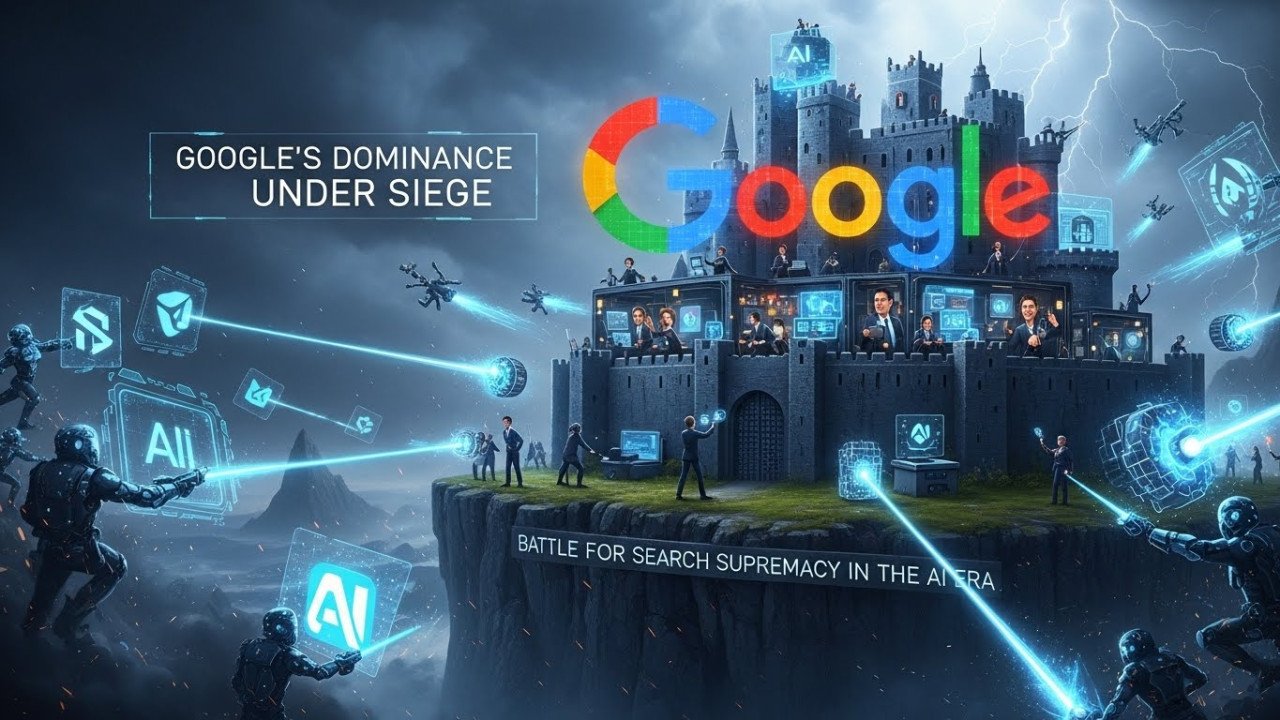
Google Search Dominance Under Siege: The 2026 Battle for AI Supremacy
Google's Dominance Under Siege: Strategic Positioning, Existential Threats, and the Battle for Search Supremacy in the AI Era
For over two decades, Google maintained an almost unassailable grip on the global search market, commanding 90% market share and generating nearly unlimited economic value from its position as the primary gateway to information. This dominance seemed resistant to disruption—strengthened by network effects, distribution advantages, and strategic partnerships that locked competitors out of critical distribution channels. Yet 2025 finds Google in an unprecedented position: innovating aggressively at its core business while simultaneously watching that core business face genuine competitive pressure from new paradigms it didn't invent.
This paradox—enormous power meeting genuine vulnerability—defines Google's current strategic position. The company grows stronger in absolute terms while losing relative advantage. Revenue climbs despite eroding market dynamics. Innovation accelerates while the fundamental business model faces structural threats. Understanding Google's present situation requires looking beyond headline metrics to examine the tectonic shifts reshaping information discovery and the strategic dilemmas those shifts create.
The Historical Dominance: How Google Built an Unshakeable Position
Google's search monopoly didn't emerge by accident. It resulted from deliberate strategic choices executed with ruthless consistency over decades.
The company pioneered the marriage of superior search quality with advertising monetization. When Google entered search, competitors like Yahoo, AltaVista, and Lycos already held larger market share. But these incumbents treated search as infrastructure—a pathway to other properties where real monetization happened. Google inverted this logic, recognizing that search itself was the monetizable asset. Every search represented a moment when users expressed explicit intent, creating unprecedented targeting precision for advertisers.
This insight created a virtuous cycle. Superior search quality drove user adoption. User volume attracted advertisers. Advertising revenue funded continuous search improvement. Competitors faced an impossible choice: abandon search as unmonopolizable, or compete directly against an adversary with vastly superior capital and accelerating advantages.
Strategic distribution deals crystallized Google's dominance. Rather than fighting for users who might drift toward competitors, Google secured default status across critical platforms. The company paid Apple approximately $20 billion annually by 2022 to remain the default iPhone search engine—effectively purchasing dominance on the world's most valuable device platform. Similar agreements with Mozilla, Samsung, and other manufacturers created contractual barriers that would-be competitors couldn't overcome through superior products alone.
The company's control of Chrome, commanding 65% of the global browser market, created additional dependency. Users accessing information through Chrome defaulted to Google Search almost unconsciously. Switching to alternatives required active choice against defaults most users never reconsidered.
This architecture produced extraordinary economic outcomes. Google generated approximately 72.5% of Alphabet's $102.3 billion quarterly revenue from advertising. Search maintained margins exceeding 40%, funding R&D investments competitors couldn't match while returning substantial capital to shareholders. The business was essentially a machine for converting human curiosity into shareholder value.
The ChatGPT Shock: When Disruption Became Real
Google's leadership remained confident in search dominance even as ChatGPT exploded in late 2022. Internally, executives debated whether conversational AI represented genuine threat or hype cycle. The consensus leaned toward the latter. Users might toy with ChatGPT, but when they needed actual information, they'd return to search. ChatGPT wasn't a search engine—it was a chatbot, fundamentally different product serving different needs.
This assessment proved partially correct but fundamentally incomplete. Yes, ChatGPT wasn't a search engine. But ChatGPT demonstrated that users would accept less optimization for comprehensiveness, precision, and speed if they received conversational naturalness, reasoning transparency, and answers formatted as guidance rather than ranked links. The technology gap between ChatGPT's raw capability and Google's search quality didn't matter if the user experience difference mattered more to actual users.
What shocked Google's leadership wasn't ChatGPT's technological sophistication—the company knew it could build equivalent or superior models. What shocked them was the realization that users preferred something fundamentally different from what Google provided. This represented not marginal improvement opportunity but existential category threat.
Inside Google, panic spread with unusual intensity. DeepMind teams scrambled to launch Sparrow, an internal chatbot intended to compete with ChatGPT. The project died as Google merged DeepMind with its AI Brain laboratory and redirected resources toward infusing generative AI throughout its product portfolio. The company recognized it faced not technological lag but strategic misstep—it had optimized search for the previous paradigm and risked being left behind as the paradigm shifted.
Google's Response: AI Overviews and the Difficult Transition
Google's strategy evolved across multiple dimensions. First, the company launched AI Overviews—AI-generated summaries appearing atop search results, synthesizing information from multiple sources rather than simply ranking links. This represented an elegant strategic move: adopt the competitive feature threatening traditional search while maintaining the platform through which it delivered the feature.
AI Overviews expanded to approximately 31% of searches by late 2025, up from nearly zero in early 2024. More significantly, they expanded from informational queries into commercial and transactional searches where monetization concentrates. This compressed expansion through the sales funnel proved crucial to Google's strategy because it demonstrated AI Overviews could enhance search without destroying advertising economics.
But AI Overviews created immediate dilemmas. Click-through rates on organic results plummeted where AI Overviews appeared—declining from 15% to 8% in comparative studies. Website operators reported traffic declines despite increases in total search volume. The paradox: searches increased but clicks decreased, benefiting Google's advertising business while harming the publishers who generated the content AI Overviews synthesized.
This asymmetry created philosophical and practical problems. Publishers increasingly questioned why they should invest in content creation when Google would simply extract, summarize, and present their information without sending traffic or revenue their direction. A few clicks from AI references provided minimal compensation for traffic losses. This dynamic threatened the fundamental web economics supporting content creation—if publishers stopped investing in original research and synthesis, what would Google's AI overviews synthesize?
Google's Liz Reid responded to traffic concerns by noting that overall searches increased, implying that the total opportunity expanded even if individual publisher outcomes worsened. This response satisfied shareholders but did little to address the economic crisis developing among content creators, journalists, and research institutions depending on search referral traffic.
Gemini and the Escalating Competitive War
Google's internal response to competitive threats accelerated dramatically through 2024 and 2025. The company launched successive iterations of Gemini—its answer to ChatGPT and other large language models—each advancing on the previous generation.
Gemini 3 Pro, launched in November 2025, represented Google's most capable model to date. LMArena benchmarking ranked Gemini 3 Pro among the top-performing models globally, competing effectively against OpenAI's offerings across creative writing, coding, reasoning, and multimodal tasks. More significantly, Gemini 3 launched directly integrated into Google Search on day one—Google wasn't hedging its bets on a separate chatbot product but betting everything on infusing its core product with generative AI capability.
This integration strategy represented a calculated gamble. By integrating AI directly into search, Google preserved its distribution advantages while attempting to neutralize the competitive threat posed by standalone AI applications. A user wanting AI-powered search experiences didn't need to abandon Google's ecosystem; they could access equivalent or superior capabilities without switching platforms.
The strategy partially succeeded. AI Overviews reached 1.5 billion monthly users, demonstrating Google's ability to rapidly scale AI-enhanced features across its enormous user base. Gemini accumulated approximately 500 million users globally. Yet these metrics, while impressive, revealed underlying tensions. Billions of users using AI enhanced search didn't guarantee permanent dominance if users simultaneously discovered they could access similar or better experiences through alternative platforms.
The Revenue Paradox: Growing While Weakening
Google's financial results through 2025 revealed a paradoxical situation. Search and related services revenue jumped 14.5% year-over-year in Q3 2025, reaching $50.7 billion. This growth substantially exceeded broader technology sector averages and continued Google's decades-long expansion trajectory. By conventional metrics, the business remained extraordinarily healthy.
Yet several concerning dynamics lurked beneath these headlines. Cost-per-click increased for 87% of industries—businesses were paying more per ad click despite reduced click-through rates on organic results. This suggested desperation rather than opportunity: as AI Overviews suppressed organic visibility, businesses compensated by increasing paid search spending. Google benefited from this shift to higher-revenue-per-search metrics, but the change signaled market distress rather than health.
Google's market share, while still dominant, fell below 90% for the first time since 2015. This seemingly marginal decline represented the first genuine erosion of near-total dominance in decades. Competitors gained share not through superior product but through shifts in how users sought information—some migrating toward specialized AI applications, others toward answer engines like Perplexity, others toward OpenAI's ChatGPT and browsing integrations.
The advertising model itself faced structural challenges. If AI-generated answers on search results pages sufficiently answered user questions, users had no reason to click through to publishers' websites, eliminating ad impression opportunities those publishers could monetize. For Google, this created an uncomfortable position: the better its AI Overviews worked, the more they suppressed the content ecosystem creating the information AI Overviews synthesized.
Emerging Competitive Threats and New Market Entrants
Google faced competition from multiple directions simultaneously, a strategic nightmare for any incumbent regardless of size.
OpenAI maintained ChatGPT's user dominance despite Gemini's superior benchmarks. Users who adopted ChatGPT and integrated it into workflows rarely switched to alternatives, creating network effects around the ChatGPT ecosystem. OpenAI's integration with web search capabilities, though imperfect, offered users a consolidated environment for both conversation and information seeking.
Perplexity AI emerged as a surprising competitive force, capturing meaningful user adoption particularly among users prioritizing privacy and transparent sourcing. Rather than attempting to replicate Google's full ecosystem, Perplexity focused on search specifically—providing fast, well-sourced answers without the baggage of Google's advertising infrastructure or privacy concerns. This specificity proved more defensible against competitive pressure than broader positioning.
Anthropic's Claude maintained substantial user adoption despite lower brand recognition than ChatGPT or Gemini. Claude's particular strengths in reasoning and analysis attracted professional users conducting sophisticated work—a potentially crucial demographic for long-term market positioning.
Most remarkably, smaller companies announced search products leveraging AI. Perplexity itself made a surprising $34.5 billion bid to acquire Chrome from Google in August 2025—an audacious move that revealed competitive confidence despite vastly lower valuation. While the bid went nowhere, it signaled the intensity of competitive conviction that search markets were genuinely contestable rather than permanently locked.
Microsoft, already integrated with OpenAI and controlling substantial cloud infrastructure, positioned itself as an alternative to Google across multiple fronts. Office 365 integration of AI capabilities competed with Google Workspace. Copilot services across Microsoft's ecosystem offered AI assistance without dependency on Google's products. While Microsoft's search initiatives hadn't displaced Google, the company's alternative ecosystem reduced Google's necessity for certain user segments.
Regulatory Threats: The Existential Pressure
Beyond competitive and market dynamics, Google faced existential regulatory threats. The U.S. Department of Justice pursued antitrust action against Google on multiple fronts—challenging the search monopoly, the advertising infrastructure, and the distribution agreements creating barrier-to-entry effects.
Most significantly, the DOJ pushed for forced divestiture of Chrome. The browser's dominance—commanding 65% global market share—created dependency on Google Search that independent competitors couldn't overcome. Removing Chrome as a default distribution channel would represent the most significant structural disadvantage Google faced since its founding. The possibility that Chrome could be sold to competitors or forced into independence created genuine strategic vulnerability.
Judge Mehta's antitrust ruling acknowledged competitive pressures from AI companies as potential disruption to Google's monopoly but noted that "structural barriers that led to Google's search monopoly remain operative in GenAI." This observation suggested that even if Google's search market dominance eroded, the company might simply recreate dominance through control of AI infrastructure and distribution if underlying leverage points remained unaddressed.
The regulatory environment created uncertainty that undermined investor confidence. Alphabet's price-to-earnings ratio compressed from a five-year average of 22.6x to 18.3x as investors processed the possibility that structural remedies could fundamentally alter Google's business model. While the stock remained valuable, the multiple compression indicated reduced confidence in perpetual dominance.
The Monetization Crisis: Can AI Search Sustain Advertising Profitability?
Perhaps Google's greatest strategic dilemma involved monetization. The company built a $100+ billion revenue business on the assumption that search results pages contained links to websites that could host advertisements. Every search represented an opportunity to display ads targeting commercial intent.
AI Overviews disrupted this equation. If users received sufficient information directly from search results pages without clicking through to publishers' websites, the advertising ecosystem collapsed. Publishers couldn't monetize traffic they didn't receive. Google could attempt to insert advertising into AI Overviews themselves, but early attempts proved clumsy and created user backlash.
Google had successfully integrated advertising into YouTube by finding natural insertion points that enhanced rather than disrupted user experience. Search advertising, developed over decades, had achieved similar naturalness and acceptance. AI-generated answer formats created no obvious place for advertising that wouldn't feel forced or misleading.
The company experimented with multiple approaches. AI Max, Google's new advertising product, attempted to maintain advertiser relationships by enabling AI-powered targeting that expanded reach despite changing search interfaces. Google inserted ads alongside AI Overviews in some tests, though results remained uncertain and user reception mixed. The company explored displaying ads within AI Mode's conversational interface—potentially effective but untested at scale.
None of these solutions addressed the fundamental problem: if users stopped visiting publishers' websites because Google answered their questions directly, the ecosystem supporting high-quality content creation would collapse. Google depended on publishers creating information it could synthesize. Destroying publishers' ability to monetize represented strategic self-sabotage.
Strategic Positioning for Long-Term Dominance: What Google Must Execute
Despite these challenges, Google retained considerable advantages in its position. The company possessed several cards remaining to play.
Vertical Integration Through Ecosystem Control: Google's dominance across Android, Chrome, Gmail, Maps, YouTube, and other properties created a unified ecosystem competitors couldn't replicate. A user integrated into Google services could access search, maps, email, documents, communication, video, and photos through a single ecosystem. Competitors offered individual products matching or exceeding Google's quality but couldn't offer the integration advantage.
Capital Resources: Alphabet's $102 billion in quarterly revenue and substantial margins generated resources dwarfing competitors' access to capital. While OpenAI, Anthropic, and others received substantial funding, they operated in entirely different financial leagues than a company generating over $50 billion in quarterly search revenue.
Distribution Moats: Despite erosion, distribution advantages remained substantial. The $20 billion annual payment to Apple maintained iPhone dominance. Similar arrangements across manufacturers created friction against competitive switching. These agreements, while under regulatory scrutiny, remained operative.
AI Research Capabilities: Google's research capability, operating at scale and with access to unique datasets, remained world-class. Gemini 3 Pro's competitive positioning against OpenAI's latest models demonstrated this capability. The company could continue advancing its AI offerings to maintain parity or achieve superiority in raw capability.
Answer Engine Opportunity: Rather than viewing AI Overviews as threat to traditional search, Google could position them as evolution—establishing new category leadership in "answer engines" that synthesized information rather than simply ranking links. Aggressive development of AI Mode, conversational interfaces, and personalization capabilities could establish Google as category leader in next-generation information discovery.
The Content Ecosystem Crisis and Sustainability Questions
Google's long-term sustainability faced an uncomfortable dependency: the company required a thriving content creation ecosystem feeding its AI systems with information to synthesize. Yet its business model incentivized reducing traffic to content creators until they could no longer afford to invest in content creation.
Industry observers increasingly questioned whether this model was sustainable. Cloudflare CEO Matthew Prince called AI answerbots an "existential threat" to the internet's business model. Publishers questioned why they should invest in creating content if Google would synthesize it without sending traffic their direction. Research institutions wondered whether the incentive structure could continue supporting original research and investigative journalism.
Google proposed solutions including potential revenue sharing with publishers whose content was referenced in AI Overviews. But implementing such systems at scale proved technically complex and economically challenging. How would Google determine which sources contributed to synthesized answers? How would it fairly compensate contributions? Could compensation models be scaled globally across languages and contexts?
These questions remained unresolved through 2025. The company seemed caught between acknowledging the ecosystem crisis and implementing meaningful solutions. Until resolution, the sustainability of Google's AI-powered information discovery remained theoretically compromised.
Market Share Erosion and the New Competitive Reality
The most telling metric was Google's market share erosion. Falling below 90% for the first time in a decade signified transition from monopoly to dominant-but-contested market. The rate of erosion remained modest—from 90% to approximately 88-89% through 2025—but the trajectory was unmistakable and unprecedented.
Competitors captured this share through different value propositions:
OpenAI offered conversational reasoning and integration with productivity applications
Perplexity emphasized speed, transparency, and privacy-first positioning
Microsoft leveraged cloud infrastructure, enterprise relationships, and Office integration
Anthropic built developer communities and positioned Claude for specialized applications
Emerging players captured users prioritizing specific features over universal platform dominance
None of these competitors represented existential threat individually. Collectively, however, they signified that the market was moving from winner-take-most toward plurality, with different competitors winning in different segments and use cases.
The AI Mode Gambit: Google's Next Strategic Phase
Google's most significant recent strategic move involved AI Mode—a conversational search interface powered by Gemini 2.5 that users activated manually (as of late 2025) but which Google executives suggested would eventually become the default experience.
AI Mode represented Google's commitment to category leadership beyond traditional search. Rather than competing only on the ranking algorithm within the existing search format, Google was attempting to establish new category: the conversational answer engine. If successful, Google would migrate users from "search engine" to "answer engine" without losing them to competitors.
This strategy acknowledged that traditional search might eventually become less valuable as AI answers became more reliable and comprehensive. Rather than defending the declining category, Google was attempting to lead the emerging category—hoping that dominance in answer engines would prove as valuable and defensible as dominance in search engines.
The gambit faced substantial risks. Users might discover they preferred competitor products. Regulators might view the transition as leveraging search monopoly into answer engine monopoly—reproducing dominance through technological transition rather than competitive merit. The business model for answer engines remained uncertain, particularly as advertising formats became less natural in conversational interfaces.
Frequently Asked Questions: Google's Future in AI Search Era
Has Google truly lost its search dominance?
No—Google maintains approximately 88-89% market share, an extraordinary position that most companies would covet. However, this represents the first significant erosion of near-total dominance since the mid-2000s. The trajectory suggests continued erosion as competing paradigms mature, but Google remains overwhelmingly dominant for now.
Could a competitor genuinely displace Google?
Possible but unlikely in medium term. Competitors would need to overcome distribution disadvantages, investment in deep ecosystem integration, and user switching costs. However, if AI-powered answer engines prove substantially superior to traditional search for most user needs, competitive switching could accelerate rapidly.
What is Google's most significant vulnerability?
Probably the advertising model dependency. If users stop clicking through to publishers' websites, the entire advertising ecosystem supporting search profitability collapses. Google hasn't proven it can monetize answer engines as effectively as search engines.
How will regulators impact Google's competitive position?
Significantly. If Chrome is forced into divestiture or independence, Google loses a critical distribution advantage that has protected dominance for decades. Other remedies affecting Android default status or Apple agreements would similarly reshape competitive dynamics substantially.
Is the web's content ecosystem at risk?
Yes, legitimately. If publishers continue losing traffic to AI-synthesized answers without adequate compensation, investment in original content creation could decline substantially. This would ultimately harm Google by reducing quality information available for AI systems to synthesize.
What's the probability Google maintains dominance through 2030?
High for the search category, though dominance in emerging answer engine category remains less certain. The company's resources, distribution advantages, and AI capability provide substantial protection, but competitive pressure will likely intensify.
Are traditional SEO practices becoming obsolete?
No, but they're evolving. Ranking in search results remains valuable, particularly for transactional queries where users click through to websites. However, becoming a source for AI-generated answers requires different optimization—structured data, clear authority signals, and content specifically formatted for AI comprehension.




Comments (0)
No comments found