


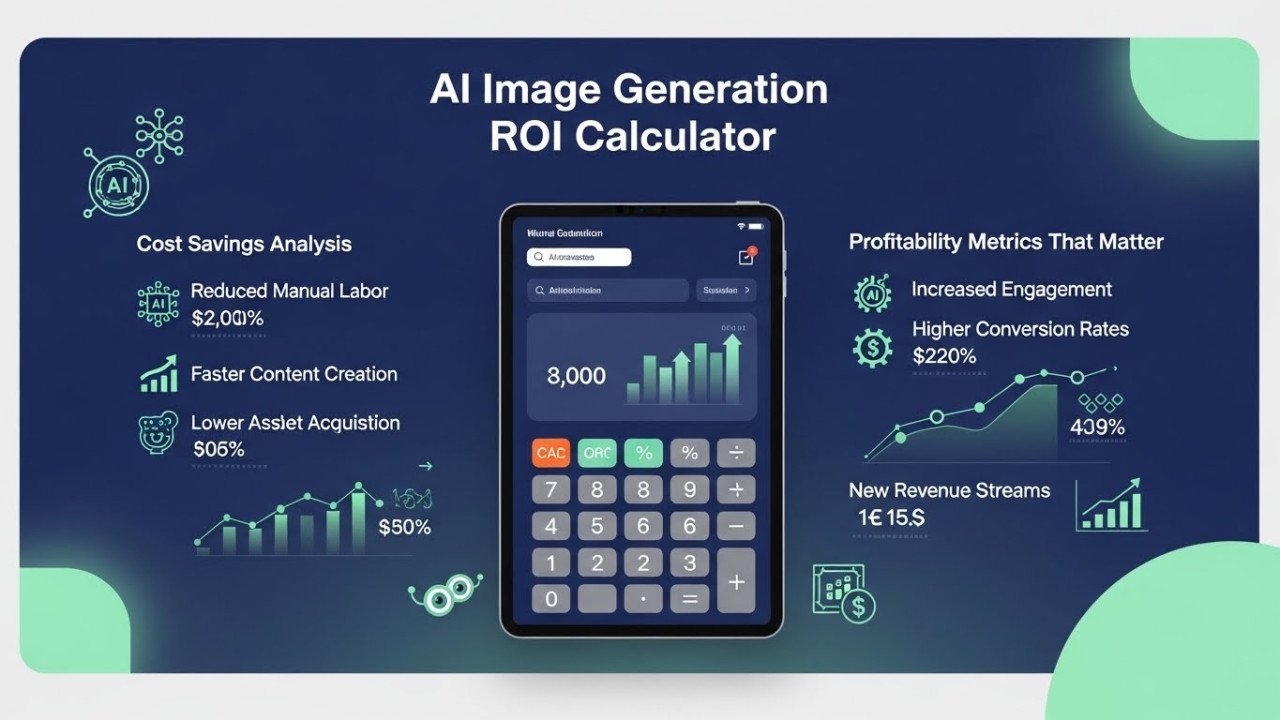
AI Image Generation ROI Calculator: Cost Savings Analysis and Profitability Metrics That Matter
AI Image Generation ROI Calculator: Cost Savings Analysis and Profitability Metrics That Matter
The ROI Question
Businesses considering AI image generation ask: What's the actual return on investment? How long until it pays for itself? What are the real cost savings vs hype?
This guide provides calculation frameworks, real-world benchmarks, and a comprehensive ROI model. By the end, you'll understand exactly what AI image generation saves (or costs) your specific business.
Understanding AI Image Generation ROI
Core ROI Formula
ROI % = (Total Savings - Total Investment) / Total Investment × 100
Breakeven Timeline = Total Investment / Monthly Savings
Example: Initial investment $5,000, monthly savings $500 → Breakeven in 10 months. After 12 months, ROI = ((6,000 - 5,000) / 5,000) × 100 = 20% ROI.
Cost Categories to Calculate
Investment (One-Time & Recurring):
- AI tool subscription (monthly): DALL-E 3 ($20), Flux ($0-100 monthly depending on usage), Stable Diffusion ($0-50 if self-hosted)
- Training and onboarding (one-time): 20-40 hours designer time ($500-2,000)
- Infrastructure setup (one-time): If self-hosting, cloud compute ($500-5,000), or if using APIs, minimal cost
- Integration/workflow tools (monthly): Project management, asset management ($50-200/month)
Savings (Quantifiable):
- Photographer/content creator labor reduction
- Physical sample/prototype cost reduction
- Time savings (faster iteration = faster time-to-market)
- Reduced revision cycles (fewer iterations needed)
- Asset library growth (reusable templates, variations)
ROI by Business Model
Model 1:E-commercee (High Image Volume)
Baseline scenario: 500-product catalog, quarterly refresh
Traditional Costs (Annual):
- Product photography: 500 products × 5 images × $1,200/product = $3,000,000 (or ~$30,000-50,000 using freelance photographers)
- Using mid-market ecommerce budget: $30,000 annually
AI-Enhanced Costs (Annual):
- DALL-E 3 subscription: $240/year
- Flux API: 2,500 images × $0.08 = $200
- Designer labor (10 hours setup): $250
- Integration tools: $500/year
- Total: ~$1,200/year
Savings: $28,800/year (96% reduction)
Breakeven: 1-2 months
Year 1 ROI: ((28,800 - 1,200) / 1,200) × 100 = 2,300% ROI**
5-Year Cost Comparison:
- Traditional: $150,000
- AI: $6,000
- 5-Year savings: $144,000
Model 2: Graphic Design Agency
Baseline scenario: 20 client projects/month, 50 images per project
Traditional Costs (Annual):
- Stock photo subscriptions: $200/month = $2,400/year
- Custom photography (20% of projects): $1,000/project × 5 projects/month × 12 = $60,000/year
- Designer time sourcing/editing images: 100 hours/month × $50/hour = $60,000/year
- Total: $122,400/year
AI-Enhanced Costs (Annual):
- DALL-E 3 ChatGPT Plus: $240/year
- Flux API (1,000 images/month × 12): 12,000 images × $0.07 = $840/year
- Designer training: $500 (one-time, spread over 5 years)
- Integration/workflow tools: $600/year
- Total: ~$2,180/year
Savings: $120,220/year (98% reduction)
Breakeven: <1 month (saves money immediately)
Year 1 ROI: ((120,220 - 2,180) / 2,180) × 100 = 5,413% ROI
5-Year Cost Comparison:
- Traditional: $612,000
- AI: $11,000
- 5-Year savings: $601,000
Model 3: Fashion/Product Design
Baseline scenario: 40 designs/season (4 seasons), 10 iterations per design
Traditional Costs (Annual):
- Sample production (160 designs × $5,000 average): $800,000
- Design consultation/iteration time (160 designs × 40 hours × $100/hour): $640,000
- Pattern development: $2,000 per design × 160 = $320,000
- Total: $1,760,000/year
AI-Enhanced Costs (Annual):
- Tool subscriptions (DALL-E 3 + Flux): $1,000/year
- AI mockup generation (160 designs × 30 mockups × $0.05): $240
- Designer training: $1,000
- Physical samples (only 20 finalists × $2,000): $40,000
- Remaining design/iteration cost (reduced by 60%): $250,000
- Total: ~$292,240/year
Savings: $1,467,760/year (83% reduction)
Breakeven: <1 month
Year 1 ROI: ((1,467,760 - 292,240) / 292,240) × 100 = 402% ROI
5-Year Cost Comparison:
- Traditional: $8,800,000
- AI: $1,461,200
- 5-Year savings: $7,338,800
Model 4: Content Creator/Social Media
Baseline scenario: 4 posts/week × 52 weeks = 200 posts/year, 3-5 images per post
Traditional Costs (Annual):
- Stock photo subscription (multiple services): $300/month = $3,600/year
- Photographer fees (occasional custom shoots): $2,000/year
- Content editor time (sourcing, editing, scheduling): 200 hours/year × $30/hour = $6,000/year
- Total: $11,600/year
AI-Enhanced Costs (Annual):
- DALL-E 3 ChatGPT Plus: $240/year
- Flux API (1,000 images/year): $80/year
- Content editor time (reduced to 50 hours/year): $1,500/year
- Total: ~$1,820/year
Savings: $9,780/year (84% reduction)
Breakeven: <1 month
Year 1 ROI: ((9,780 - 1,820) / 1,820) × 100 = 437% ROI
5-Year Cost Comparison:
- Traditional: $58,000
- AI: $9,100
- 5-Year savings: $48,900
Hidden Costs (Often Overlooked)
Cost #1: Training and Ramp-Up Time
Reality: Designers need 2-4 weeks to become proficient with AI tools and prompt engineering
Cost: 40-80 hours × $40-60/hour = $1,600-4,800 (one-time)
Impact: Initial productivity dip (20-30% slower) for first 2-4 weeks, then 40-60% productivity gain thereafter
Cost #2: Tool Integration and Workflow Adjustment
Reality: Integrating AI into existing workflows requires adjustments to project management, asset storage, and review processes
Cost: 30-60 hours one-time = $1,200-2,400, plus $50-200/month for integration tools
Cost #3: Quality Assurance and Review
Reality: AI outputs require human review and approval (not a magic button—still requires expertise)
Cost: 20-30% of designer time for QA/approval vs 5-10% traditionally
Impact: Net time savings still 40-60% despite QA overhead
Cost #4: Tool Switching and Lock-In Risk
Reality: If you become dependent on one AI tool and it changes pricing/availability, switching costs money
Mitigation: Avoid over-specialization; keep skills portable across tools
Benefits Beyond Cost Savings
Benefit #1: Time-to-Market Acceleration
Traditional: 8-12 weeks from concept to published product photography
AI-Enhanced: 2-4 weeks from concept to published images
Monetary Value: Faster time-to-market = capturing seasonality better, faster response to trends, first-mover advantage in fast categories
Estimated Impact: 5-15% revenue increase from faster market responsiveness (very category-dependent)
Benefit #2: Design Exploration and Iteration
Traditional: Produces 3-5 design variations (expensive to produce more)
AI-Enhanced: Produces 30-50+ design variations (cheap to explore more options)
Monetary Value: Better design selection = higher conversion rates, fewer failed products, stronger product-market fit
Estimated Impact: 5-10% conversion rate improvement = significant revenue lift for e-commerce
Benefit #3: Asset Library Creation
Traditional: Each project starts from scratch (no asset reuse)
AI-Enhanced: Build reusable templates, variations, background libraries (exponentially accelerates future projects)
Monetary Value: By year 2-3, the marginal cost of new projects drops 70-80% (amortisation)
Estimated Impact: 20-30% additional cost reduction in years 2+
ROI Calculator Framework
Step 1: Calculate Current Annual Costs
Identify all image-creation spending:
- External photographers/videographers: $_____
- Stock photo subscriptions: $_____
- Designer labor (hours spent sourcing/editing images × hourly rate): $_____
- Design tool subscriptions (Canva, Adobe, etc.): $_____
- Prototyping/sampling costs: $_____
- Asset management/storage tools: $_____
- Total Current Annual Cost: $_____
Step 2: Calculate AI Implementation Costs
First-Year (including setup):
- AI tool subscriptions (DALL-E 3, Flux, etc.): $_____/year
- Training/onboarding (hours × rate): $_____
- Infrastructure/integration setup: $_____
- Workflow adjustment tools: $_____
- Year 1 Implementation Cost: $_____
Ongoing Annual (Year 2+):
- AI tool subscriptions: $_____/year
- Integration tool subscriptions: $_____/year
- Training/skill maintenance: $_____/year
- Ongoing Annual Cost: $_____
Step 3: Calculate Labor Savings
Current labor dedicated to image creation:
- Designer/photographer hours per month: _____
- Hourly rate (salary/2,080 hours): $_____
- Annual labor cost: _____ × _____ × 12 = $_____
Projected labor savings (typically 40-70%):
- Reduction percentage: _____%
- Annual labor savings: _____ × ____% = $_____
Step 4: Calculate Other Savings
- Photography/sampling costs reduction: $_____ (typically 80-95% reduction)
- Stock photo subscription elimination: $_____ (if applicable)
- Tool consolidation (eliminate redundant subscriptions): $_____ (typically $100-300/month)
- Total Additional Annual Savings: $_____
Step 5: Calculate Net ROI
Year 1:
- Total Savings: Labor + Sampling + Other = $_____
- Total Investment: Implementation + Subscriptions = $_____
- Net Benefit: _____ - _____ = $_____
- ROI %: (Net Benefit / Investment) × 100 = ____%
- Breakeven Timeline: Investment / Monthly Savings = _____ months
5-Year Projection:
- Year 1: $_____ (includes setup cost)
- Year 2-5: $_____ per year (annualized benefit without setup)
- 5-Year Total Benefit: $_____ - $_____× 4 = $_____
Real-World ROI Examples with Numbers
Example 1: Small E-commerce Store
Current State: 100 products, refresh annually with a freelance photographer ($200/product = $20,000/year) annually.
Year 1 AI Cost: $1,200 (subscriptions + training)
Year 1 Savings: $20,000 - $1,200 = $18,800
ROI Year 1: (18,800 / 1,200) × 100 = 1,567%
Breakeven: ~1 month
Example 2: Mid-Size Design Agency
Current State: 15 designers, 30% of time spent on asset sourcing/editing = 450 hours/month × $50/hour = $27,000/month in labor
Year 1 AI Cost: $3,000 subscriptions + $2,000 training = $5,000
Year 1 Savings: (450 hours × 50% productivity gain) × $50 × 12 = $135,000
ROI Year 1: (135,000 / 5,000) × 100 = 2,700%
Breakeven: <1 month
Example 3: Fashion Brand
Current State: 50 designs/season, $3,000/design sample production + design/iteration = $150,000/season = $600,000/year
Year 1 AI Cost: $5,000 subscriptions + $5,000 training = $10,000
Year 1 Savings: Reduce samples by 80% (only produce 20 finalists): $600,000 - (200 × $2,000) = $600,000 - $400,000 = $200,000
ROI Year 1: (200,000 / 10,000) × 100 = 2,000%
Breakeven: <1 month
When ROI Isn't Positive
Scenarios Where AI Image Generation Doesn't Pay Off
1. Very Low Volume (<100 images/year)
If your business generates <100 images annually, the tool cost ($20-50/month minimum) may exceed savings. Recommendation: Use pay-as-you-go API ($0.04-0.10/image) rather than subscriptions.
2. Highly Specialized Requirements
If you need very specific custom imagery (unique brand assets, proprietary designs), AI output quality may not meet standards. Manual review/revision costs may offset savings. Recommendation: Hybrid approach (AI for rough drafts, professional finishing).
3. Premium Brand Positioning
If brand equity depends on "authentic" photography (luxury goods, high-end portraiture), AI disclosure may damage perception. The cost of brand risk may exceed the cost savings. Recommendation: Use AI for internal/non-customer-facing work only.
4. Existing Sunken Costs
If you have sunk $100,000 into photography infrastructure/studio, switching to AI abandons that investment. Recommendation: Depreciate investment, compare ongoing marginal costs (not total costs).
Related Articles for ImageCreatAI
- AI Photography Revolution 2026: Strategic Adaptation & Market Survival Guide
- AI Image Generation Mastery 2025: Expert Strategies for Studio-Quality Results
- AI Image Generation for Designers 2026: Strategic Implementation & Competitive Advantage
- DALL-E 3 vs Midjourney vs Flux Tested: Which AI Generator Actually Delivers for Marketing Teams
- Copyright and Legal Risks in AI Image Generation: What Businesses Need to Know Before Using AI Art
- Image Generation for Ecommerce: Complete Workflow From Product Photos to Scale (With Real ROI Data)
- Fashion Design with AI: Creating Mockups, Prototypes, and Design Variations at Scale
FAQs
Q1: What's the Average Payback Period?
A: 1-3 months for most businesses. E-commerce and design agencies see payback within weeks. Content creators 2-4 weeks. Only very low-volume operations take 6+ months.
Q2: Do Scale Economies Improve ROI Over Time?
A: Yes,s dramatically. Year 1 ROI 200-500%. Year 2+ ROI 500-1,000%+ because setup costs are amortised, team proficiency increases, and asset libraries are reusable.
Q3: What If Quality Requirements are Very High?
A: Even with premium tools (Flux + manual touchup), ROI is positive because the time saved (the highest cost) outweighs quality issues. The hybrid approach (AI + professional finishing) is still 60-80% ROI positive.
Q4: Should I Compare to Stock Photos or Professional Photography?
A: Compare to your actual current cost. If using stock photos ($50-200/month), ROI is lower but still positive (3-6x). If using professional photographers, ROI is extremely high (10-50x).
Q5: What About Opportunity Cost?
A: Factor in revenue impact from faster time-to-market and more design iterations. Content creators publishing 2x as fast may see a 20-30% traffic increase. Fashion brands launching designs 60% faster may capture seasonality better. These benefits often dwarf direct cost savings.
Q6: Is ROI Guaranteed?
A: Essentially yes for high-volume image producers. Cost savings are mathematically almost certain. Quality/adoption risks exist (if the team rejects the AI output, savings don't materialise). Mitigate by starting with non-critical work, proving value, and scaling gradually.
Final ROI Verdict
For image-intensive businesses (e-commerce, agencies, fashion, content creators), AI image generation ROI is exceptional: 200-2,000% year one, with payback periods typically under 3 months.
Even conservative estimates: $1,000-5,000 investment, $10,000-100,000+ annual savings, positive ROI within months.
Biggest value: not cost savings alonebut a combination of cost reduction + time acceleration, + design exploration. Net impact: faster to market, better design decisions, lower costs.
For most businesses generating 100+ images annually, AI image generation is among the highest-ROI technology investments possible. Expected 2-3 year payoff period minimum; many see ongoing 5-10x ROI sustainably.


Comments (0)
No comments found