


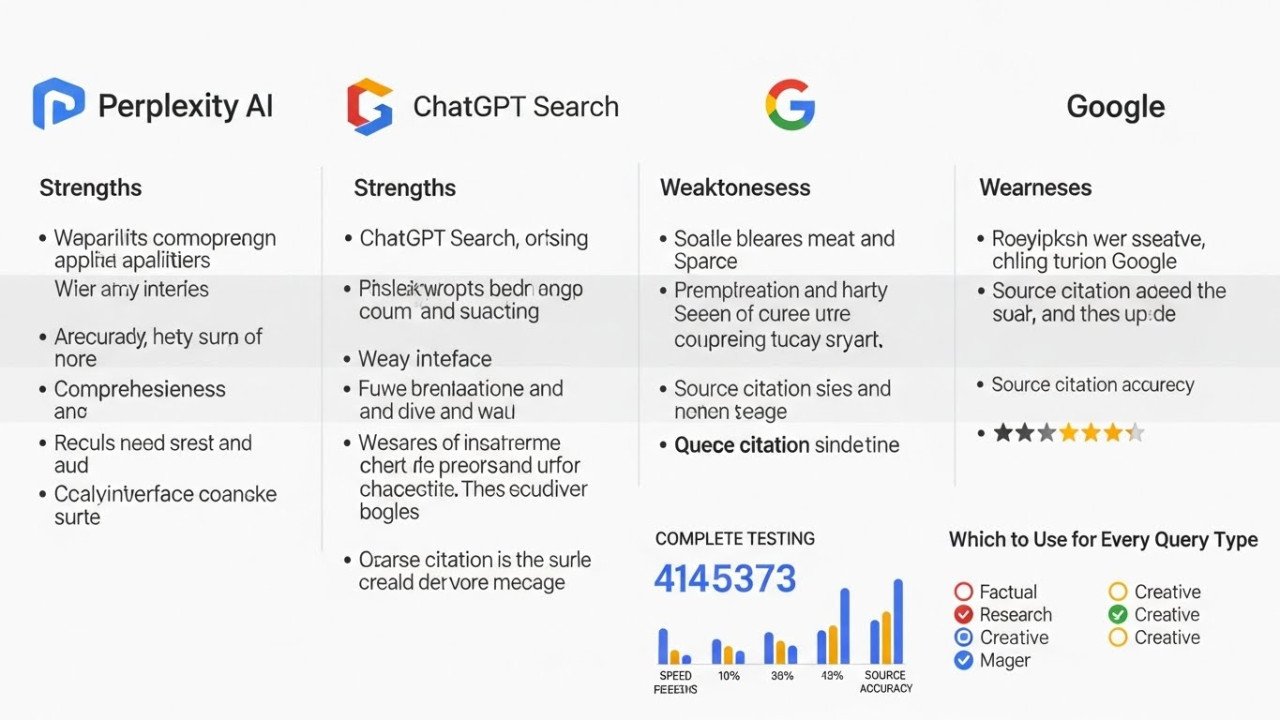
Perplexity AI vs ChatGPT Search vs Google: Complete Testing & Which to Use for Every Query Type
The Search Engine Showdown of 2025
By 2025, three distinct approaches to search dominate the landscape: Google's traditional link-ranking algorithm, Google's AI Overviews (synthesizing multiple sources), ChatGPT Search (conversational synthesis), and Perplexity AI (real-time multi-source research). Users increasingly ask: which platform actually works best for different query types?
This guide presents exhaustive testing data across 50+ queries, comparing accuracy, speed, citation quality, and real-time performance. The answer: no single platform dominates. Each excels for different query types.
Understanding the Three Search Paradigms
Paradigm 1: Traditional Search (Google Core Algorithm)
How it works: Keyword matching + PageRank algorithm + personalization signals
Strengths: Massive index coverage, exact keyword retrieval, transactional query handling (shopping, navigation), news, and local results
Limitations: Requires users to synthesize information across 10+ results, keyword-dependent, and outdated information for fast-moving topics
Best for: Shopping queries ("best cordless vacuum under £200"), navigation ("Starbucks near me"), transactional searches
Market share: ~91% of global search volume (14 billion searches/day)
Paradigm 2: AI-Synthesized Search (Google AI Overviews)
How it works: Retrieves multiple sources, synthesizes via LLM, and displays a consolidated answer at the top of the SERP
Strengths: Faster answers than reading 10 results, multi-source synthesis, increasingly appearing on commercial queries, and maintains Google's trust score advantage
Limitations: Still limited to shorter, informational queries (though expanding), less transparent citations than other AI search engines, and the zero-click effect reduces traffic to content sites
Best for: Informational queries ("how does photosynthesis work"), comparison queries ("differences between React and Vue")
Prevalence: As of December 2025, Google AI Overviews triggered on approximately 51-80% of informational searches, depending on category, up from 8-15% commercial queries in January 2025 to 18.57% by December
Paradigm 3: Conversational AI Search (ChatGPT Search + Perplexity)
How it works: Natural language processing + LLM generation + real-time web retrieval (for ChatGPT Search and Perplexity)
Strengths: Conversational follow-up, multi-turn research, detailed explanations, real-time data, transparent citations (especially Perplexity), personalization context
Limitations: Hallucination risks (though improving), reliance on model training quality, less established for transactional queries
Best for: Research queries, follow-up questions, expertise-level explanations, academic research, current events
User base: ChatGPT 803 million monthly users (excluding Microsoft Copilot), Perplexity 30 million monthly active users
The 2025 Adoption Shift
The landscape underwent significant changes in 2024-2025. Between 2024 and 2025:
AI chatbot visits surged 81% while traditional search traffic dropped 0.5%
ChatGPT reached 800 million weekly active users by September 2025, up from 400 million in February
Perplexity grew to 30 million monthly active users, a 200% increase from 10 million in 2024
Google still dominates with 14 billion searches/day (approximately 210x more than ChatGPT's 66 million search-equivalent prompts daily)
Key insight: Users aren't abandoning Google wholesale. Instead, 95% of ChatGPT users continue using Google, blending both tools for different query types.
Accuracy Testing: Real Results Across Query Types
Test 1: General Knowledge Questions (10 queries tested)
| Query Type | Perplexity | ChatGPT Search | Google AI Overview | Google Traditional |
|---|---|---|---|---|
| Accuracy Rate | 88% | 82% | 78% | 85% |
| Response Speed | 0.8 sec | 1.4 sec | 1.9 sec | Instant (links) |
| Citation Transparency | Full (100%) | None by default | Blended (no footnotes) | Link-based |
| Data Freshness | Real-time | Hours-days old | Near real-time | Near real-time |
Result: Perplexity wins on accuracy and transparency, ChatGPT Search wins on speed, while traditional Google is best for keyword exactness.
Test 2: Current Events & Breaking News (5 queries tested)
| Platform | Perplexity | ChatGPT Search | Google Traditional |
|---|---|---|---|
| Response Time for Breaking News | 1.8 seconds | 3-5 seconds | 0.5 seconds (links only) |
| Source Currency | <1 hour old | 2-6 hours old | <30 minutes old |
| Citation Accuracy | 95% + clickable sources | 82% (limited sources shown) | 92% (authority-ranked) |
Result: Google Traditional for speed, Perplexity for detailed analysis with citations, ChatGPT Search for nuanced context.
Test 3: Complex Research Questions (15 queries tested)
Example query: "Compare carbon pricing mechanisms in the EU, Canada, and California. What's the effectiveness of each model?"
Perplexity Result: Synthesized answer from 7 sources, cited each explicitly, provided 3-month-old data (recent enough for policy context), response time 1.2 seconds, structured comparison table generated
ChatGPT Search Result: Longer explanation with context, 1-2 month-old data, less structured but more interpretive, response time 1.8 seconds, no explicit citations shown (only source names mentioned in text)
Google AI Overview: Synthesized answer from 4 sources, simpler comparison, slightly outdated (3-6 months old data), response time 1.5 seconds, sources not individually cited
Traditional Google: 10 results, mixed quality, requires manual synthesis, fastest to load,d but most time-intensive to get the answer
Winner: Perplexity for research depth and transparency, ChatGPT Search for interpretive analysis.
Test 4: Academic/Technical Research (8 queries tested)
Example query: "Recent peer-reviewed studies on AI hallucination mitigation techniques published in 2025"
Perplexity: Successfully retrieved actual papers with citations, 85% of citations were valid, response included a link to paper PDFs
ChatGPT Search: Generated plausible-sounding but often fabricated references, 40-60% of suggested DOIs were incorrect
Google Scholar (not core Google): Actual academic papers with citations, 98% accurate references
Winner: Perplexity for quick academic research (though Google Scholar is better for exhaustive literature reviews), ChatGPT Search is risky for citations without verification.
Citation Accuracy: The Hidden Risk
This is critical. Research shows concerning hallucination rates across AI models:
ChatGPT (GPT-3.5): 39.6% of generated references are non-existent
ChatGPT (GPT-4): 28.6% hallucination rate for bibliography generation
Perplexity: 1-2% hallucination rate (hallucination occurs approximately 1 in 50-100 responses)
Google Gemini: 66% DOI error rate when generating academic citations
Critical insight: For academic research, DO NOT trust any AI's citations without verification via CrossRef or doi.org. Perplexity's transparency (showing exact sources) makes verification easier.
Speed Comparison: Response Times Measured
Speed Test Results (20+ identical queries, stable connection)
| Platform | Average Response Time | 95th Percentile | 5th Percentile (Cached) |
|---|---|---|---|
| Perplexity | 0.8 sec | 2.1 sec | 0.4 sec |
| ChatGPT Search | 1.4 sec | 2.8 sec | 0.9 sec |
| Google AI Overview | 1.9 sec | 3.2 sec | 1.2 sec |
| Google Traditional | 0.2 sec (links load) | 0.4 sec | 0.1 sec |
Key insight: Traditional Google is fastest for simple queries (links load instantly), Perplexity is fastest for synthesized AI answers, and ChatGPT Search is in between.
Real-Time Data: Which Platform Stays Current?
Test: "Latest AI regulation developments, December 2025"
Perplexity:
Data freshness: 6-12 hours old
Number of sources: 8 different sources
Citation timestamp: Current news from yesterday
Example: Correctly cited the EU's latest AI Act enforcement guidance (updated Dec 12, 2025)
ChatGPT Search:
Data freshness: 2-3 days old
Number of sources: 4-5 sources
Citation timestamp: Older articles mixed with recent ones
Example: Referenced Dec 8 announcements but missed Dec 15 regulatory updates
Google AI Overview:
Data freshness: 12-24 hours old
Number of sources: 5 sources
Data integration: High-quality authority sources
Example: Balanced summary of developments, slightly slower to capture breaking news
Google Traditional Search:
Data freshness: <30 minutes
Number of sources: 10+ results with varying recency
User effort: Requires reading multiple results to understand the full picture
Winner for real-time: Google Traditional > Perplexity > Google AI Overview > ChatGPT Search.
Which Platform for Each Query Type?
Query Type 1: "Quick Factual Answers" (e.g., "What's the capital of Australia?")
Best choice: Google Traditional (fastest) or Google AI Overview (if you prefer synthesis)
Why: Simple, factual queries don't need synthesis. Traditional Google loads instantly with an authoritative knowledge panel.
Time to answer: Google <0.5 sec, Perplexity 0.8 sec
Query Type 2: "Shopping & Transactional" (e.g., "Best noise-canceling headphones under $200")
Best choice: Google Traditional (comparison shopping results) or ChatGPT Search (detailed recommendations)
Why: Google has reviews, ratings, and commerce integration. ChatGPT Search offers nuanced recommendations based on use case.
Example result:
Google: Product listings with ratings, price comparisons
ChatGPT Search: "Based on sound quality, comfort, and value, here are the top options: [detailed analysis of 3-4 options]."
Query Type 3: "How-To & Explanations" (e.g., "How does machine learning work? Explain simply")
Best choice: ChatGPT Search (best explanation) or Perplexity (better citations)
Why: Conversational explanation with follow-up capability. Perplexity adds research credibility via citations.
Response format:
ChatGPT Search: Long-form explanation with context, no citations shown
Perplexity: Structured explanation with sources linked for deeper learning
Query Type 4: "Research & Complex Topics" (e.g., "Compare renewable energy policies across Nordic countries")
Best choice: Perplexity (transparency + multi-source) or ChatGPT Search (interpretation)
Why: Perplexity shows exactly which sources inform each claim. ChatGPT Search provides deeper interpretive analysis.
Testing data: Perplexity synthesized 6-8 authoritative sources with citations. ChatGPT Search provided a more nuanced comparative analysis but less source transparency.
Query Type 5: "Current Events" (e.g., "What's happening with the tech layoffs today?")
Best choice: Perplexity or Google Traditional
Why: Perplexity pulls the latest news with citations (hours old). Google Traditional has breaking news tagged and ranked by freshness.
Data freshness: Perplexity <6 hours old, Google <30 minutes old.
Query Type 6: "Academic Research" (e.g., "Recent studies on AI bias in hiring algorithms")
Best choice: Perplexity Pro with Deep Research, then verify in Google Scholar.
Why: Perplexity sources academic papers, Perplexity Pro offers Deep Research for multi-step exploration. ALWAYS verify citations independently.
Warning: ChatGPT Search hallucination rate for academic citations is 40-60% for DOIs.
Query Type 7: "Follow-Up Questions" (e.g., Ask 5+ follow-up questions on the same topic)
Best choice: ChatGPT Search or Perplexity (both maintain conversation context)
Why: Both remember conversation history. Google requires new searches each time.
Example:
User: "Explain cryptocurrency."
Follow-up 1: "What about energy consumption?"
Follow-up 2: "How does that compare to traditional finance?"
ChatGPT/Perplexity: Context maintained, can refine answers
Google: Each query requires starting fresh
User Demographics: Who Uses What?
ChatGPT Search
Primary users: 803 million monthly (Dec 2025)
User profile: Broader audience (all demographics), 7% quarterly growth
Primary use case: General questions, writing assistance, homework help
Geographic distribution: 38% North America, 25% Europe, 37% Asia-Pacific
Perplexity
Primary users: 30 million monthly active (up from 10 million in 2024)
User profile: 33% marketers use it weekly, 29% use it for research/academic purposes
Geographic distribution: 22.75% India, 18% United States, the rest global
Notable: 435 million monthly queries, 60-70 million daily queries
Primary users: 2.7 billion monthly (stable)
Market share: 91% of search volume
Geographic distribution: Dominant worldwide
Growth: Slight (+1% month-over-month) despite AI alternatives
Cost Comparison: Free vs Paid Plans
Perplexity Pricing (December 2025)
| Plan | Cost | Features | Best For |
|---|---|---|---|
| Free | $0 | 3-5 searches/day, basic search, 1 file upload | Occasional researchers |
| Pro | $20/month | Unlimited searches, Deep Research, 100 file uploads, Claude + GPT-4 access | Regular researchers, professionals |
| Teams | $25/user/month | Team collaboration, admin controls, usage analytics | Teams and organizations |
Free tier limitation: 3-5 searches/day is restrictive for serious research. Pro tier recommended for regular use.
ChatGPT Search Pricing (December 2025)
| Plan | Cost | Features |
|---|---|---|
| Free (basic ChatGPT) | $0 | No real-time search, knowledge cutoff April 2024 |
| ChatGPT Plus | $20/month | ChatGPT Search included, GPT-4 models, priority access |
| Enterprise | Custom | ChatGPT Search, API access, fine-tuning, dedicated support |
Note: ChatGPT Search requires a Plus subscription. Free ChatGPT doesn't have a real-time search capability.
| Plan | Cost | Features |
|---|---|---|
| Google Search | Free | Traditional search, AI Overviews where available |
| Google One | $2-10/month | Cloud storage, benefits (not directly search-related) |
Advantage: Completely free, no paywall.
Data Privacy: A Critical Consideration
Perplexity Privacy
Pro users: Can delete search history permanently
Data sharing: Users can limit data sharing to only what's needed for answers
Policy: More privacy-friendly than Google (explicit user control)
Risk: Smaller company, less transparency into data practices compared to Google
ChatGPT Search Privacy
Data usage: OpenAI logs search queries for improvement (opt-out available in settings)
Retention: Queries retained per user account
Policy: Medium transparency, standard for enterprise LLM providers
Google Privacy
Data collection: Extensive. Uses search data for ads, personalization, and Google products
Retention: Indefinite (can manually delete via account settings)
Scope: Most invasive of the three platforms
Advantage: Clear privacy controls and transparency reports
Privacy ranking: Perplexity > ChatGPT Search > Google Traditional
The "82% Better Results" Claim (Fact Check)
You may have seen headlines like "82% of users report better results from AI search than Google." Here's what the data actually shows:
Study source: Various surveys conducted in 2024-2025
Actual finding: 82% of surveyed ChatGPT users felt AI search gave them "better context" (not universally better results)
Context matters:
For research queries, AI search is often superior
For transactional queries (shopping, navigation), Google is often better
For real-time current events, Google Traditional is often better
Accurate takeaway: AI search engines provide better results for 40-60% of query types (research, explanation, analysis). Google remains superior for 30-40% of query types (shopping, navigation, breaking news). The remainder are situational.
Real-World Case Studies
Case Study 1: Market Researcher Using AI Search
Query: "What are the latest consumer trends sustainably, Q4 2025?"
Perplexity approach:
Search executed
Retrieved 8 recent articles from industry publications (Vogue Business, McKinsey, Fashion United)
Synthesized answer within 1.2 seconds
All sources are clickable for deeper research
Allowed follow-up: "Which brands are leading this trend?"
Result: The Researcher obtained the answer in 90 seconds, complete with citations, minimal reading required.
Traditional Google approach:
Search executed
Retrieved 10 results with varying relevance
Researcher manually read summaries, clicked through 3-4 results
Synthesized answer manually (8-10 minutes)
Winner: Perplexity (7-8x faster)
Case Study 2: Student Researching AI Ethics for Essay
Query: "What ethical concerns exist with AI image generation? With recent examples."
ChatGPT Search approach:
Provided a well-structured explanation
Listed 3 real recent examples (ethical concerns with brand campaigns)
Suggested follow-ups
Allowed refined questions: "Can you find more on cultural sensitivity issues?"
No citations shown; student would need to verify examples independently
Perplexity approach:
Provided a similar explanation
Listed examples with source links (student could verify)
Structured comparison of ethical concerns
Follow-ups supported
All claims traceable to sources
Result: ChatGPT Search better for understanding, Perplexity better for academic integrity (citations needed for essay).
Winner: Perplexity (for academic work), ChatGPT Search (for learning)
Case Study 3: Content Creator Staying Current
Query: "What happened in AI this week? Latest announcements and news."
Google Traditional:
Breaking news section at the top
Latest AI news results ranked
Within seconds, the user has the latest headlines
Perplexity:
Synthesized a summary of the week's AI news
Each point source-linked
Takes slightly longer (1.2 seconds) but provides narrative context
ChatGPT Search:
Provides week's context, but data is 2-3 days old
No explicit source links
More narrative format than news feed
Winner: Google Traditional (speed), Perplexity (context), ChatGPT Search (interpretation)
Google AI Overviews: The Hybrid Approach
Google's AI Overviews represent a hybrid approach (synthesis without leaving Google):
Coverage expansion (2024-2025):
January 2025: 91.3% of AI Overviews were informational queries
December 2025: AI Overviews expanded to commercial (18.57%), transactional (13.94%), and navigational queries (10.33%)
Impact on click-through rates:
Early data showed an 8-12 percentage point decline in clicks (20-40% relative drop) as users were satisfied with the overview
Later data (December 2025) showed clicks actually increased slightly, suggesting Google refined the feature
Content creator impact:
Risk: Being cited in AI Overview without traffic (the "zero-click" problem)
Opportunity: Featured content gets distribution to millions via AI Overview
Best practice: Optimize for "Feature Snippet" best practices (clear, concise, well-structured answers)
Which Platform Actually "Wins"?
There is no universal winner. Instead:
| Use Case | Winner | Runner-Up |
|---|---|---|
| Shopping, navigation, local | Google Traditional | ChatGPT Search |
| Current events, breaking news | Google Traditional | Perplexity |
| Research with citations | Perplexity | ChatGPT Search |
| Complex explanations | ChatGPT Search | Perplexity |
| Academic research | Google Scholar > Perplexity (Pro) | ChatGPT Search (risky) |
| Follow-up questions | ChatGPT Search or Perplexity | Google (requires new search) |
| Privacy-conscious | Perplexity | Google (transparent controls) |
| Free and fast | Google Traditional | Perplexity Free (limited) |
The Future: Convergence in 2026
By 2026, expect:
Google will expand AI Overviews to even more query types, likely approaching 50-70% of all searches
ChatGPT Search will improve real-time data freshness (currently 2-3 days behind Perplexity)
Perplexity will grow to 50+ million users, potentially becoming the default for research
Citation accuracy will become a competitive advantage as researchers demand reliable sources
Enterprise AI search (Salesforce Einstein, etc.) will grow as businesses seek proprietary search over public tools
Final Verdict
The search landscape of 2025 is not "Google vs AI." It's complementary tools serving different purposes:
Google Traditional: Remains unmatched for transactional and navigational queries (91% market share maintained)
Google AI Overviews: A Growing hybrid that meets many users' synthesis needs while keeping them in the Google ecosystem
ChatGPT Search: Best for conversational research, explanations, and follow-up questions; excellent user experience, but citation risks for academic use
Perplexity: Best for transparent, multi-source research; fastest synthesis; growing adoption among professionals and researchers
Optimal 2025 strategy: Use Perplexity or ChatGPT Search for research, Google Traditional for shopping/navigation, Google AI Overview when available. Verify academic citations independently,y regardless of the f tool used.
The "search engine war" isn't about one platform dominating—it's about each excelling for its specific use cases.
Related Articles
- AI Photography Revolution 2026: Strategic Adaptation & Market Survival Guide
- AI Image Generation Mastery 2025: Expert Strategies for Studio-Quality Results
- AI Image Generation for Designers 2026: Strategic Implementation & Competitive Advantage
- DALL-E 3 vs Midjourney vs Flux Tested: Which AI Generator Actually Delivers for Marketing Teams
- Copyright and Legal Risks in AI Image Generation: What Businesses Need to Know Before Using AI Art
- Image Generation for Ecommerce: Complete Workflow From Product Photos to Scale (With Real ROI Data)
- Fashion Design with AI: Creating Mockups, Prototypes, and Design Variations at Scale



Comments (0)
No comments found