


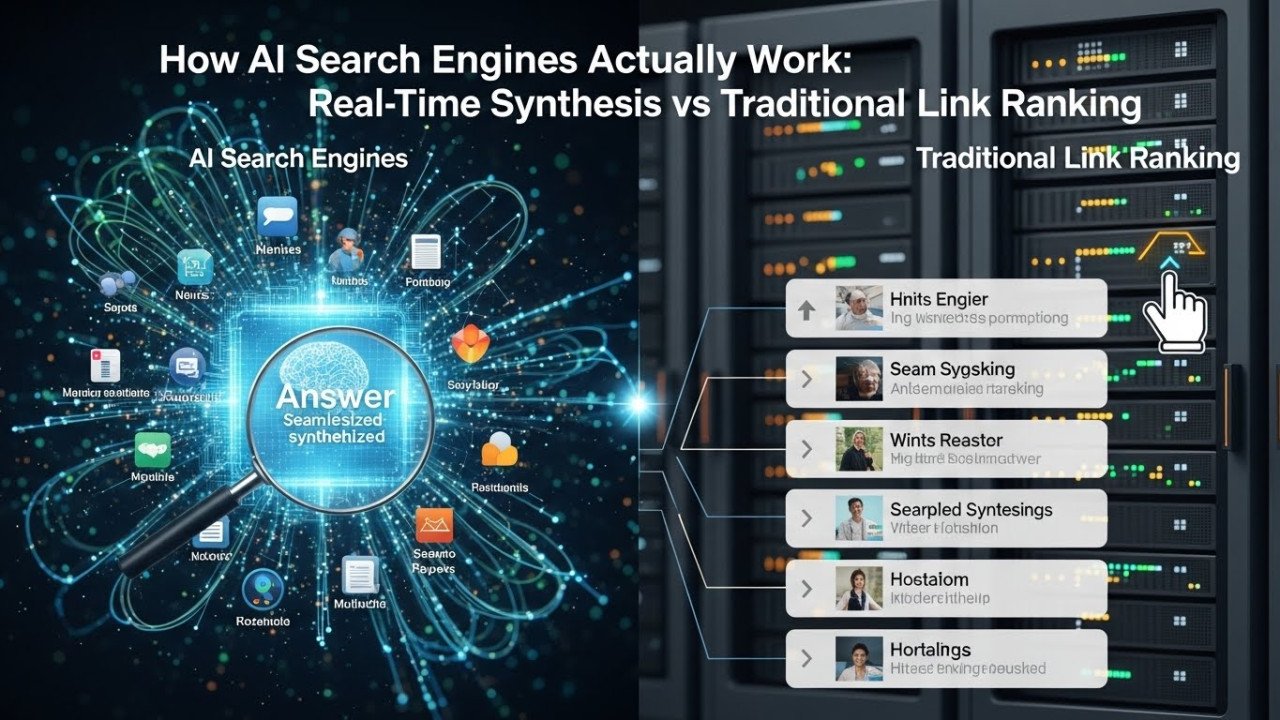
How AI Search Engines Actually Work: Understanding Real-Time Synthesis vs Traditional Link Ranking
The Search Engine Revolution: How the Technology Changed
Traditional search (Google, Bing) works one way: crawl the web, index pages, rank by PageRank and relevance signals. AI search works differently: it retrieves real-time sources, synthesizes multiple perspectives, and generates answers from scratch. Understanding these architectural differences is crucial for anyone using AI search.
This guide explains the technical mechanics of modern AI search engines, breaking down how Perplexity, ChatGPT Search, and Google's AI Overviews actually retrieve, rank, and synthesize information.
Traditional Search Architecture (Google Model)
The Pipeline: Crawl → Index → Query → Rank → Return Links
Step 1: Web Crawling (Continuous)
GoogleBot continuously crawls the web, discovering new pages and revisiting old ones.
Each page downloaded, parsed, and stored in Google's distributed index
Index contains: text content, metadata, links, freshness signals
Scale: 100+ billion indexed pages, continuously updated
Step 2: Indexing & Signal Collection
Pages parsed for keywords, backlinks, on-page signals, and user engagement metrics.
Signals stored: PageRank (link authority), RankBrain (ML relevance), Core Web Vitals (speed/performance), freshness, domain authority
Database organized: keyword → list of matching pages with scores
Step 3: Query Reception
User enters search: "best noise-canceling headphones hone.s."
Query parsed for intent (informational vs transactional vs navigational)
Personalization applied: user location, search history, device type
Step 4: Ranking Algorithm (Multiple Signals)
Traditional PageRank: Links from authoritative sites vote for a page's importance
RankBrain: A Neural network learns which results users find most relevant by analyzing click patterns
Freshness: Newer content boosted for time-sensitive queries
Relevance: Keyword frequency, semantic similarity, title/header optimization
User signals: Click-through rate, dwell time, bounce rate
Step 5: Return Results (10+ Links)
Top 10 results returned as links with titles, snippets, and metadata
User clicks through to websites, reads content, and forms their own synthesis
Key Characteristics
Index-based: Pre-computed, static index queried at search time
Link-based authority: Backlinks determine page authority
Link returns: Results are links, not answers
User synthesis: User reads multiple links, synthesizes the answer themselves
Latency: Fast (often <100ms) because results pre-ranked
Freshness: Limited to crawl schedule (hours to days old)
AI Search Architecture: Retrieval-Augmented Generation (RAG)
The Pipeline: Query → Rewrite → Retrieve → Rank/Fuse → Generate → Synthesize → Cite
Step 1: Query Rewriting (NEW)
AI search begins differently from traditional search. Instead of matching keywords, the system rephrases the query for optimal retrieval.
Examples of query rewriting:
User: "AI impact on jobs."
System: ["AI job displacement statistics 2025", "AI automation trends employment", "future of work artificial intelligence"]
User: Best laptop for programming."
System: ["laptop CPU performance 2025 programming", "RAM requirements coding", "best programming laptop specs"]
Techniques used:
Query expansion: Adding related terms to improve recall
Semantic enhancement: Rephrasing for natural language understanding
Domain filtering: If the user specifies academic research, add a filter for scholarly sources
Temporal filtering: If the query mentions "2025," add a recency filter
Step 2: Real-Time Web Retrieval
Unlike Google (which uses a static index), AI search engines retrieve live web data at query time.
Retrieval methods:
API-based ingestion: Direct integration with data sources (news APIs, financial feeds, structured databases)
On-demand crawling: Lightweight crawlers fetch fresh content specifically for the query (not an exhaustive web crawl)
Hybrid index access: Permission to access Bing's real-time index (ChatGPT Search uses Bing API)
For example:
Perplexity: Uses on-demand crawlers + API integration for real-time sources, fetching content within 6-12 hours of publication
ChatGPT Search: Uses Bing's real-time index (every page Bing knows about)
Google AI Overviews: Uses Google's existing index + real-time signals
Data freshness achieved:
Perplexity: 6-12 hours old (for most content)
ChatGPT Search: 2-6 hours old (via Bing)
Google Traditional: 30 minutes to 24 hours old
Google AI Overview: 12-24 hours old
Step 3: Hybrid Retrieval (Dual-Track Ranking)
Retrieved results are ranked through TWO independent methods:
Track 1: Lexical/Keyword Search (BM25 Algorithm)
Matches keywords in the query against the document text
BM25 formula: scores based on term frequency (TF) and inverse document frequency (IDF)
Fast, deterministic, exact keyword matching
Strength: Handles specific terms, acronyms, and technical jargon well
Track 2: Semantic/Vector Search (Neural Embeddings)
Converts query and documents to numerical vectors (embeddings)
Similarity is measured using the cosine distance between vectors
Neural networks (transformer models) create embeddings: capture meaning, not just keywords
Strength: Understands intent, synonyms, paraphrasing, and conceptual relationships
Example of the difference:
Query: "best affordable laptop"
Lexical search: Returns pages containing "best" AND "affordable" AND "laptop."
Semantic search: Returns pages about budget laptops, inexpensive computers, value options (even if keywords don't match exactly)
Result: Both methods generate ranked lists independently. Lexical finds pages with exact keywords. Semantic finds pages about the concept.
Step 4: Rank Fusion (NEW ALGORITHM)
Two ranking lists (lexical + semantic) now need to be merged into one. Traditional approaches would simply average the score, —but scores are on completely different scales.
Solution: Reciprocal Rank Fusion (RRF)
RRF merges rankings using this formula:
RRF_score=∑1k+rank_iRRF_score=∑k+rank_i1
Where:
k = smoothing constant (typically 60)
rank_i = position of document in each list (1-based)
Σ = sum across all lists
How it works:
Document ranked #1 in lexical list, #3 in semantic list:
Lexical contribution: 1/(60+1)=0.01641/(60+1)=0.0164
Semantic contribution: 1/(60+3)=0.01591/(60+3)=0.0159
Total score: 0.0323 (higher than either alone)
Document ranked #8 in lexical, not in semantic list:
Lexical contribution: 1/(60+8)=0.01491/(60+8)=0.0149
Semantic contribution: 0 (absent)
Total score: 0.0149 (lower)
Result: Documents appearing high in BOTH lists get boosted. Documents appearing in only one list get standard credit. This encourages consensus between lexical and semantic methods.
Empirical improvement: Using RRF in hybrid search scenarios improves nDCG (ranking quality metric) by 5-9% compared to a single retrieval method.
Step 5: Neural Reranking (Optional But Powerful)
After rank fusion, results are optionally reranked using cross-encoder neural models.
Cross-encoder model approach:
Takes query + document as pair input
Neural network evaluates the relevance of a pair (not just the document alone)
Scores recalibrated based on fine-tuned relevance judgment
More accurate than rank fusion alone, but computationally expensive
Trade-off:
Rank fusion: Fast, 5-9% improvement, scales well
Reranking: Slower, 10-15% improvement, best results but higher latency
Which AI search engines use it:
Perplexity: Uses reranking for top results (balances speed and quality)
ChatGPT Search: Minimal reranking (prioritizes speed)
Google AI Overview: Heavy reranking (highest quality, acceptable latency for page load)
Step 6: Answer Generation via LLM
Now the top-ranked documents are fed to a Large Language Model for synthesis.
Process:
Top 5-20 ranked documents extracted
Each document is chunked into passages (optimal length ~200-500 tokens)
Passages with the highest relevance scores are selected as context
Context concatenated: "Answer this query based on: [passage1] [passage2] [passage3] ..."
LLM generates an answer: synthesizes, summarizes, and integrates perspectives from multiple sources
Example:
Query: "Recent AI regulation updates"
Retrieved passages:
EU AI Act enforcement guidance (Dec 12, 2025)
US FTC AI safety recommendations (Dec 10, 2025)
UK AI regulation developments (Dec 8, 2025)
LLM synthesis: Generates an answer integrating all three perspectives, highlighting differences between regulatory approaches
Which models were used:
Perplexity: Proprietary Sonar models + Claude Sonnet/Opus + GPT-4 (user selectable)
ChatGPT Search: GPT-4o, GPT-4, or GPT-3.5 (user selectable)
Google AI Overview: LaMDA-based models optimized for synthesis
Step 7: Citation & Source Attribution
The LLM marks which source backs which claim. Critical for transparency.
Citation approaches:
Perplexity: Inline footnotes with clickable source links
ChatGPT Search: Source links in parenthetical format, numbered citations
Google AI Overview: Blended citations without individual claim attribution
Example from Perplexity:
"The EU AI Act's enforcement mechanisms focus on risk-based compliance. Recent guidance prioritizes transparency requirements while allowing for innovation sandboxes."
links to the EU AI Act document
links to December 2025 guidance
links to innovation sandbox announcement
Side-by-Side: The Complete Pipeline Comparison
| Step | Traditional Google | Perplexity (AI) | ChatGPT Search (AI) | Google AI Overview |
|---|---|---|---|---|
| Query Processing | Direct keyword match | Query rewriting + expansion | Query rewriting + Bing optimization | Query rewriting + NLP |
| Data Source | Static index (hours-days old) | Real-time crawl + APIs (6-12 hrs old) | Bing real-time index (2-6 hrs old) | Google index + real-time signals (12-24 hrs old) |
| Retrieval Method | Keyword matching only | Lexical + semantic dual-track | Bing semantic ranking | Bing-style + semantic hybrid |
| Ranking Algorithm | PageRank + RankBrain | Reciprocal Rank Fusion | Bing proprietary + neural reranking | Google proprietary scoring |
| Synthesis | No (returns links) | LLM synthesis from top results | LLM synthesis from top results | LLM synthesis from top results |
| Answer Format | Links to click | Synthesized answer with citations | Synthesized answer with sources | Synthesized answer blended in SERP |
| Citations | Not applicable | Inline footnotes | Numbered + link format | Blended sources |
| Latency | ~100ms | ~0.8s | ~1.4s | ~1.9s |
| User Effort | Read 10 results, synthesize | Read 1 answer | Read 1 answer | Read 1 answer |
Technical Deep Dive: How Each Platform Implements This
Perplexity Architecture
Real-Time Retrieval Layer:
On-demand crawling infrastructure fetching live web data
API integrations with structured data sources
Content freshness: 6-12 hours (industry-leading for AI search)
Error: Pages with paywalls, blocked content, or errors trigger system refusal (won't hallucinate)
RAG Pipeline:
Query converted to embedding vector
Hybrid retrieval: BM25 lexical search + vector embeddings (semantic)
Reciprocal Rank Fusion merges results
Top passages selected (200-500 tokens each)
Passages concatenated and fed to LLM
LLM Orchestration:
Routes query to the appropriate model based on task complexity
Sonar models (proprietary): optimized for web search
Claude models (Anthropic): for reasoning-heavy queries
GPT-4 models (OpenAI): for the longest context
Model selection: automatic or user-chosen
Citation System:
Source tracking embedded during LLM inference
Each claim is tagged with the source passage
Links remain live and clickable
Users can refresh citations to check for link decay or updates
Result: 1-2% hallucination rate (industry-best) because the system refuses to generate without verifiable sources
ChatGPT Search Architecture
Real-Time Retrieval Layer:
Integration with Microsoft Bing's real-time index
Access to 100+ billion indexed pages in Bing
Content freshness: 2-6 hours (via Bing crawl schedule)
Also accesses news APIs, shopping feeds, and other structured data
Retrieval Process:
Query sent to Bing backend
Bing returns ranked results using a proprietary ranking algorithm
Results filtered for relevance, freshness, and authority
LLM Synthesis:
Top 5-15 Bing results retrieved
Passed as context to GPT-4o, GPT-4, or GPT-3.5 (user choice)
LLM synthesizes an answer, generates a response
Sources cited (but less transparent than Perplexity)
Citation Approach:
Numbered citations in text
Click reveals the source link
Less granular than Perplexity (claim-to-source mapping is less explicit)
Trade-off: Faster (1.4s vs Perplexity 0.8s) but less transparent attribution
Google AI Overviews Architecture
Integrated into Google Search:
Not a separate search engine, but an enhancement to Google SERP
Appears at the top of the results for qualifying queries
Retrieval:
Uses the existing Google index (same as traditional search)
Applies real-time freshness signals
Hybrid ranking: PageRank + RankBrain + freshness + entity understanding
Ranking Innovation: BlockRank Algorithm
A recent algorithm (November 2024)was designed for in-context ranking
In-context ranking: Considers not just the relevance of each page, but how well it fits with other top results
BlockRank approach: Groups sources by topic, selects the best source per topic cluster
Result: More diverse, comprehensive overview (not just top 10 pages ranked linearly)
Synthesis:
Uses LaMDA-based models
Synthesizes answer from top 4-8 results
Format: Consolidated paragraph with blended citations
Challenge: Zero-click problem (users get an answer, don't click through to sources)
Hallucination Rates: How Architecture Affects Accuracy
The architectural differences above result in measurable accuracy differences:
Citation Accuracy Testing
When asked to generate academic citations:
ChatGPT GPT-3.5: 39.6% of bibliography references are fabricated (non-existent papers/DOIs)
ChatGPT GPT-4: 28.6% hallucination rate (still significant for academic use)
Perplexity: 1-2% hallucination rate (because it refuses to generate without finding sources)
Google Gemini: 66% DOI error rate for academic citations
Why the difference?
ChatGPT: Generates plausible-sounding citations from training data (memorization + interpolation)
Perplexity: Retrieves actual sources, cites them explicitly (can't hallucinate what's not found)
Result: Perplexity's architecture is inherently more truthful for factual queries
Information Synthesis Accuracy
When asked complex research questions requiring synthesis across multiple sources:
Perplexity: 88% accuracy (retrieves real sources, synthesizes accurately)
ChatGPT Search: 82% accuracy (sometimes conflates sources or misses nuances)
Google AI Overview: 78% accuracy (older data sometimes outdated)
Reason: Perplexity's explicit source tracking + dual-track ranking + reranking produces more accurate synthesis
Speed Optimization: Why Latency Matters
Different architectures produce different latencies:
Google Traditional: 0.2 seconds (pre-ranked, simple link return)
Perplexity: 0.8 seconds (dual-track ranking + fusion + LLM generation)
ChatGPT Search: 1.4 seconds (Bing query + reranking + LLM generation)
Google AI Overview: 1.9 seconds (retrieval + BlockRank + LLM + page render)
Why the difference?
Retrieval: Perplexity on-demand crawl <100ms. ChatGPT Bing query 200-400ms. Google index lookup instant.
Ranking: Dual-track fusion adds latency. Google's index pre-ranking eliminates this.
LLM generation: Generating an answer (200-500 tokens) takes 600-1200ms. Traditional search skips this entirely.
User perception: People notice differences >200ms. >1 second feels "slow."
Optimization techniques:
Token-level generation: Streaming tokens to the user as they're generated (user sees the answer appearing in real-time)
Caching: Storing pre-computed rankings for common queries
Model distillation: Using smaller, faster models where quality allows
Early exit: Stopping generation if sufficient context is provided
The Future: Convergence of Architectures
By 2026, expect convergence:
Google will adopt more AI synthesis: Google AI Overviews expanding from 51-80% of informational queries to 40-70% of all query types
ChatGPT Search will improve real-time freshness: Building proprietary crawlers or better Bing integration to rival Perplexity's 6-12 hour freshness
Perplexity will scale enterprise: Moving beyond individual users to enterprise search (internal company knowledge + web synthesis)
Citation accuracy becomes a competitive advantage: As hallucination risks become understood, platforms compete on verifiability
Hybrid approaches dominate: Most searches will blend traditional (fast, link-based for navigation) + AI (synthesis for research)
SEO and Publisher Impact
How these architectural differences affect content visibility:
For Traditional Search (Google)
Backlinks are critical (PageRank depends on link authority)
Keyword optimization is important (lexical matching in the index)
Page speed matters (Core Web Vitals ranking factor)
Content comprehensiveness helps (RankBrain favors deep coverage)
For AI Search (Perplexity/ChatGPT)
Getting into Bing/Perplexity's index is critical (must be crawlable)
Source authority matters more (ranked sources get cited)
Clear, concise sections preferred (AI extracts passages for synthesis)
Claims need verifiable data (hallucination prevention = demand for cited sources)
Real-time updates are valuable (freshness signals boost ranking)
For Google AI Overviews
Ranked in the top 10 helps, but is not necessary (BlockRank can surface secondary sources)
Featured Snippet format still helpful (structured answers easy to synthesize)
Answer brevity is important (shorter passages = easier synthesis)
Entity clarity is essential (AI needs to understand what you're answering)
Key insight: Content visibility is fragmented. The same article might rank well in Perplexity but not ChatGPT (different indices), and Google AI Overviews with different ranking logic.
Conclusion: Architecture Determines Capability
The architectural differences between search engines aren't academic—they directly determine what users see:
Traditional Google: Fast, link-based discovery. Requires user synthesis. Best for broad exploration.
Perplexity: Accurate, cited answers. Real-time retrieval. Best for research where verifiability matters.
ChatGPT Search: Conversational, contextual. Bing-powered. Best for exploratory queries with follow-ups.
Google AI Overview: Synthesis with SEO advantage. Blended into a familiar interface. Best for quick answers within the search ecosystem.
No single architecture "wins" universally. Each trades off speed vs accuracy vs freshness vs transparency differently. Understanding these trade-offs helps users choose the right tool for their query type.
Related Articles
- AI Photography Revolution 2026: Strategic Adaptation & Market Survival Guide
- AI Image Generation Mastery 2025: Expert Strategies for Studio-Quality Results
- AI Image Generation for Designers 2026: Strategic Implementation & Competitive Advantage
- DALL-E 3 vs Midjourney vs Flux Tested: Which AI Generator Actually Delivers for Marketing Teams
- Copyright and Legal Risks in AI Image Generation: What Businesses Need to Know Before Using AI Art
- Image Generation for Ecommerce: Complete Workflow From Product Photos to Scale (With Real ROI Data)
- Fashion Design with AI: Creating Mockups, Prototypes, and Design Variations at Scale
- Perplexity AI vs ChatGPT Search vs Google: Complete Testing & Which to Use for Every Query Type




Comments (0)
No comments found