


Practical AI Applications Beyond ChatGPT: How Enterprises Actually Use Generative AI to Drive Revenue
The ChatGPT Myth: Enterprise AI Isn't About Chat Anymore
In 2025, enterprises spent $37 billion on generative AI—3.2x the $11.5 billion spent in 2024. But only a fraction deployed ChatGPT-style interfaces for employee chat. Instead, 47% of AI investment went directly to production workflows: document processing, code generation, sales pipeline automation, and customer service systems that operate without human intervention. The inflection point has passed. Generative AI is no longer a tool employees interact with—it's infrastructure embedded inside revenue operations.
The application layer alone—software built on top of AI models—captured $19 billion, 51% of total enterprise AI spending. There are now 10 products generating over $1 billion in annual recurring revenue (ARR) and 50 generating over $100 million. None is ChatGPT. All solve production problems. The companies winning are automating specific, measurable workflows. Those experimenting with "what if we give everyone ChatGPT access" are reallocating budgets elsewhere.
Document Automation: The Fastest Path to Measurable ROI
Invoice and document processing is the clearest win. Uber's GenAI-powered invoice automation system processed global supplier invoices with a 2x reduction in manual handling time. The system achieved 90% accuracy overall—35% of invoices reached 99.5% accuracy, 65% exceeded 80%. Average handling time dropped 70%. Cost savings: 25-30% compared to the annual baseline. Payback period: immediate—the system eliminated labor costs within months of deployment.
The implementation integrated optical character recognition (OCR), natural language processing (NLP), and business rules engines into a single workflow. The system extracted vendor details, amounts, and dates automatically. It reconciled invoices against purchase orders and payment records without human review. For edge cases requiring human judgment, it built an intuitive interface enabling staff to correct 1-2 misclassified fields per batch and move on. The key: 70% accuracy wasn't the goal. 80%+ accuracy on 65% of volume—eliminating the easiest 65% of labor—was profitable enough to scale.
Financial Services Invoice Automation
Across the financial services industry, invoice processing automation reduced manual data entry time by 40-60%. Accounting teams shifted from clerical work to strategic analysis. Error rates dropped from 5-8% manual rates to under 1% AI-assisted rates. Companies deploying AI for invoice processing alongside accounts payable workflows reported 20-30% total process cost reduction. The pattern repeats across manufacturing, healthcare, and retail: when you automate the first 60-70% of volume with reasonable accuracy, the economics justify the investment overnight.
Missing data remains the constraint. Finance teams report that 15-20% of invoices contain missing or conflicting information (mismatched vendor IDs, currency conversions, regional tax structures). Generalist AI models struggle with this ambiguity. Specialized systems trained on industry-specific patterns perform better. A manufacturing company reported 84% accuracy on its vendor invoices after retraining on historical data. An insurance processor achieved 92% after adding domain-specific rules for claim attachments. The takeaway: off-the-shelf generative AI works for 60% of volume. Getting to 85%+ requires custom fine-tuning or a hybrid human-AI review.
Code Generation: Productivity Gains With Quality Costs
Over 60% of organizations using AI code generation tools report at least 25% productivity improvements. Among developers experiencing "considerable" gains, 70% also reported higher code quality when proper code review infrastructure was in place. This matters because raw speed without review led to the opposite: faster delivery, lower quality. Continuous AI-powered code review is the force multiplier.
Here's the execution pattern: developers using Copilot or Claude generate code 30-50% faster. Boilerplate, API integrations, and repetitive patterns are assembled by AI. But quality degrades without automated review. Teams deploying AI code review tools saw 81% report quality improvements. Teams speeding up without review? Only 55% saw quality gains. The implication is that AI writes serviceable code—but human oversight still matters. Shipping code without review isn't faster. It's riskier.
Developer Velocity Metrics
Companies measuring velocity after AI adoption track cycle time (work from start to deployment), pull request size, and time-to-completion for specific tasks. Cycle times compressed 15-25% in teams with mature practices. Pull request sizes shrank when developers broke work into smaller chunks. Time to complete feature implementation dropped 20-35%. But these gains concentrated in teams with AI-assisted review. Teams without formalized code review saw productivity gains of 10-15%, not 25-40%.
The hidden cost: hallucinations and model drift. AI models generate confident-sounding code that fails at runtime. Developers encounter incompatible library versions, missing error handling, and logic errors. Code analysis tools flagged high-severity issues in 17% of AI-generated pull requests. Teams that integrated automated code scanning—analyzing generated code before human review—reduced defects by 40-50%. Those running code as-is experienced production incidents months later. AI makes developers faster at writing code. It makes them slower at catching bugs unless you instrument the workflow correctly.
Sales Pipeline Automation: Orchestration Replaces Heroics
Enterprise sales evolved from individual rep heroics to orchestrated systems. AI agents now handle qualification, routing, and follow-up at scale. One multinational enterprise documented a 30% reduction in regional performance variance after deploying an AI-driven lead qualification. The variance reduction didn't come from better selling—it came from consistent execution. AI applied identical qualification logic across North America, EMEA, and APAC, adjusting language while preserving rigor. Regional managers could no longer hide underperformance under inconsistent processes.
Call initiation and lead qualification reduced average response time from hours to minutes in a 12-country B2B organization. The downstream effect was a and measurable increase in qualified opportunity creation without hiring. Faster contact meant better conversations. Better conversations meant cleaner data. Cleaner data enabled more precise routing. The compounding effect created a 15-20% revenue acceleration over 12 months.
AI Sales Agents: Early Indicators and Pipeline Movement
Leading indicators emerge quickly: reduced speed-to-contact (average time from lead arrival to first conversation), higher first-conversation completion rates, improved data completeness in CRM systems. One SaaS organization reduced average response time from 2 hours to 8 minutes through AI-driven inbound routing. First-contact completion rates (conversations that qualified or disqualified the prospect in a single call) increased from 35% to 62%. These metrics matter because they compound. Faster contact converts to higher-quality conversations. Quality conversations accelerate pipeline movement.
Enterprise sales AI architectures integrate real-time transcribers, intent classifiers, and live-transfer orchestration. When an AI agent qualifies a lead, it transcribes the conversation, extracts objections, scores readiness, and pre-briefs the human seller before live transfer. The seller enters the conversation with situational awareness—not discovery fatigue. Close rates improve not because conversations are longer but because handoffs feel intentional. Context is preserved. Buyers experience coherence.
One challenge: compliance and voicemail. AI agents must obtain consent before recording. They must handle rejections gracefully. Voicemail detection prevents wasted call attempts. Call timeout settings optimize when agents attempt follow-up. Orchestration complexity increases with scale. Systems that handle thousands of concurrent conversations across multiple channels (call, SMS, email) require enterprise architecture: token-based authentication, message queuing, timeout management, and fallback pathways. Teams neglecting infrastructure spend months debugging production issues.
Customer Service Automation: Reaching Sub-5-Minute Resolution
AI customer service agents are closing conversations in 2-5 minutes that humans resolve in 11 minutes. Klarna's customer service AI agent reduced average resolution time dramatically while maintaining satisfaction. Traditional systems route tickets and provide information. Next-generation systems resolve issues autonomously using natural language processing, sentiment analysis, and context understanding. When escalation is necessary, the agent transfers with full interaction history, reducing resolution time further.
Autonomous Issue Resolution Patterns
The clearest wins come from well-defined issues: password resets, order status, billing inquiries, return initiation. AI systems resolve these in 70-80% of cases autonomously. When escalation occurs, human agents already know customer sentiment, issue complexity, and previous interaction history. Resolution time for escalated cases drops because discovery is complete. Customer satisfaction increases because they're not repeating information.
Operational savings accumulate fast. One e-commerce organization reported: 78% first-contact resolution (up from 45% baseline), 65% reduction in average handling time, 23-point CSAT increase. Annual benefit: $180,000 labor savings plus $75,000 from satisfaction-driven retention. Payback period: 1.4 months. But this assumes proper implementation. Systems deployed without context understanding (pre-conversation history, account type, previous interactions) perform worse—often lower satisfaction than baseline because customers explain problems twice.
Real Revenue Impact Across Departments
Marketing and Content
Marketing platforms captured $660 million in 2025 enterprise AI spending. Real use cases: campaign optimization, content generation, audience segmentation, and dynamic personalization. One e-commerce platform used AI for real-time product recommendation and dynamic pricing. Results: 5x higher conversion rates, 216% increase in average order value, 24% uplift in incremental revenue, 30% reduction in campaign costs, 32x ROI. These results exceeded ChatGPT case studies because the system was engineered for a specific business outcome—revenue—not exploration.
IT Operations
IT operations tools reached $700 million in spending—the fastest-growing segment. Use cases: incident response automation, infrastructure management, predictive alerting, and vulnerability detection. Organizations report a 40-50% reduction in mean-time-to-resolution (MTTR) for common incidents. Critical incidents (database failure, network outage) still require human judgment. But routine incidents—certificate expiration, disk space, memory leaks—are handled autonomously. IT teams shift from reactive firefighting to strategic capacity planning.
Customer Success
Customer success tools captured $630 million—handling ticket routing, sentiment analysis, and proactive outreach. AI agents identify at-risk accounts based on usage patterns, engagement decline, and sentiment signals. They trigger proactive outreach before churn occurs. One SaaS company reported: 12% reduction in churn through AI-driven early warning, 18% improvement in customer health scores, 5% revenue uplift from retention-driven expansion. These gains came from automating what humans struggled to do at scale: constant monitoring across 5,000+ accounts and immediate intervention.
The Constraint: Data Quality and System Integration
84% of AI projects encounter data quality problems. This is the single largest reason for failure. Scattered data across multiple systems affects 78% of initiatives. Missing historical data requires a complete project redesign. An organization deploying AI sales agents discovered its CRM had duplicate customer records, inconsistent data entry, and missing engagement history. The AI agent couldn't score leads accurately because the underlying data was corrupted. They spent 3 months cleaning data before meaningful productivity gains appeared.
Integration complexity compounds the problem. Document automation systems must integrate with ERP software. Code generation tools must work within existing CI/CD pipelines. Sales agents must sync with Salesforce in real-time. Each integration takes longer than expected. Custom mappings, authentication delays, and schema mismatches consume engineering time. One organization budgeted 8 weeks for Salesforce integration and consumed 16 weeks. They discovered their custom fields and workflows required special handling that vendor documentation didn't cover.
Hidden Costs That Derail Deployments
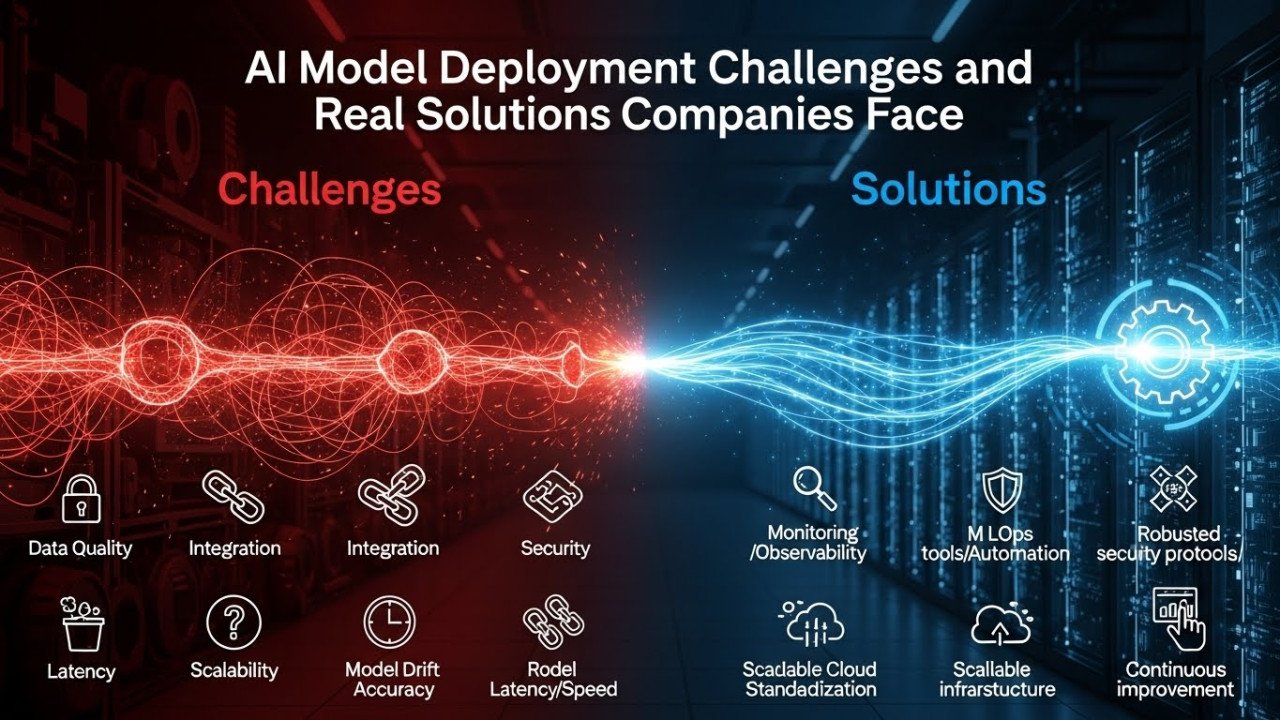
Model drift and retraining: AI model accuracy degrades 15-25% within six months without retraining. Continuous monitoring is mandatory. An invoice processing system that achieved 90% accuracy when deployed degraded to 73% accuracy after six months because vendors changed invoice formats, and the model saw new patterns. Retraining consumed 4-6 weeks and required labeled data. Many organizations don't budget for ongoing maintenance, creating a false impression that AI "just works."
HITL (Human-in-the-Loop) overhead: Systems achieving 80%+ accuracy still require human review of edge cases. Uber's invoice system needed HITL validation. Customer service systems escalate 15-25% of cases. Document automation systems flag 10-15% for human correction. The labor cost of HITL review often offsets automation savings if not designed properly. Organizations that invest in effective UI for human review minimize this friction. Those treating HITL as an afterthought find that it consumes more labor than the original process.
Change management resistance: Processes change when AI deploys. Sales reps lose lead qualification work. Customer service agents handle harder cases. Accounting teams shift from data entry to analysis. Not all employees adapt instantly. Adoption rates stall if change management is neglected. One organization deployed a $2M sales automation system and saw only 40% rep adoption in month three. Reps found workarounds to avoid using the system. Actual productivity gains took 6-8 months to materialize after adding training and leadership accountability.
Key Takeaways
- Document Automation Wins Fast: Invoice processing, contract extraction, and financial document automation deliver 25-30% cost reduction and measurable ROI within 3-6 months. Data quality constraints are real but solvable with custom fine-tuning.
- Code Generation Needs Review Infrastructure: Faster writing without code review creates technical debt. Teams with AI-powered code review achieve 81% quality improvement. Teams without it see mixed results and production incidents.
- Sales Automation Is About Orchestration: Fastest wins come from consistent lead qualification and routing, not better selling conversations. Variance reduction and pipeline acceleration follow system design, not model sophistication.
- Customer Service Automation Scales Only With Context: Sub-5-minute resolution is achievable for well-defined issues. Escalations require full conversation history. Implementation quality determines outcomes.
- Data Quality and Integration Are the Real Constraints: 84% of projects encounter data problems. Clean data and deep system integration matter more than model sophistication. Budget extra time for integration and data remediation.
- Model Drift Is Invisible Until It's Critical: Accuracy degrades 15-25% in six months. Continuous monitoring and retraining are mandatory, not optional. Organizations that treat this as a one-time deployment fail.
- Change Management Determines Adoption: Process change disrupts workflows. User adoption determines whether AI investments deliver value. Neglecting change management delays ROI by 6-8 months or kills projects entirely.
The Verdict: Generative AI as Production Infrastructure
Enterprise generative AI has moved past experimentation. Companies deploying it for specific, measurable workflows—invoice automation, code review, sales qualification, customer service—are generating 15-70% efficiency gains and revenue acceleration. The competitive divide isn't between "AI adopters" and "non-adopters." It's between organizations that integrated AI as embedded production systems versus those treating it as optional employee tools. The $37 billion invested in 2025 proves which approach wins.
Related Articles
- Image Generation for Ecommerce: Complete Workflow From Product Photos to Scale (With Real ROI Data)
- Fashion Design with AI: Creating Mockups, Prototypes, and Design Variations at Scale
- Perplexity AI vs ChatGPT Search vs Google: Complete Testing & Which to Use for Every Query Type
- Google AI Overviews: Why They're Killing SEO Traffic (And How to Adapt)
- AI Search vs Traditional SEO: The Skills You Need to Master in 2025
- Real-World AI ROI: Case Studies Showing 300–650% Returns Across Industries (With Exact Metrics



Comments (0)
No comments found